Who is Ahmad Vahidi, Iran’s IRGC New Commander?
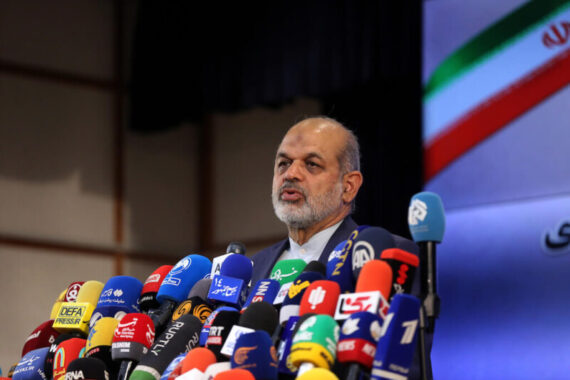
Ahmad Vahidi served as defense minister under former president Mahmoud Ahmadinejad and later became interior minister in the administration of President Ebrahim Raisi.
March 6, 2026
A
hmad Vahidi is a senior Iranian military and political figure who has recently been appointed commander of the Islamic Revolutionary Guard Corps (IRGC), one of the most powerful institutions in Iran. His appointment comes at a critical moment, as Iran faces a large-scale military confrontation with the United States and Israel.
Vahidi assumed leadership of the IRGC after the deaths of several senior Iranian commanders during the war with Israel and the United States. His predecessor, Mohammad Pakpour, was killed during the initial phase of the joint U.S.-Israeli attacks in February 2026. Pakpour himself had replaced Hossein Salami, who was killed earlier during the 2025 war with Israel.
This rapid turnover highlights the danger surrounding the position. The IRGC has previously lost prominent commanders, including Qassem Soleimani, the former head of the elite Quds Force who was killed in a U.S. drone strike ordered by then-U.S. President Donald Trump in 2020.
Vahidi has been involved with the Revolutionary Guards since shortly after the Iranian Revolution. During the 1980s he rose through the organization’s ranks, holding positions in intelligence and military leadership.
Iranian state media report that he commanded the IRGC’s external operations branch, the Quds Force, from 1988 to 1997. He later handed the role to Soleimani, who expanded Iran’s regional influence across the Middle East until his assassination in 2020.
In December 2025, Iran’s then-Supreme Leader Ali Khamenei appointed Vahidi as deputy commander of the IRGC, positioning him as a key figure in preparing Iran’s forces for potential conflict.
Unlike some previous IRGC commanders, Vahidi has also held important civilian posts in the Iranian government.
He served as defense minister under former president Mahmoud Ahmadinejad and later became interior minister in the administration of President Ebrahim Raisi. His experience across both military and political institutions has given him strong influence within Iran’s security establishment.
Recommended
Vahidi has also been the subject of international controversy. In the late 2000s, Interpol issued a red notice for him at the request of Argentina over alleged involvement in the 1994 bombing of the AMIA Jewish Community Center, which killed 85 people. Iranian officials have denied any role in the attack.
He has also been sanctioned by the European Union and the United States over Iran’s crackdown on protests following the death of Mahsa Amini in police custody in 2022.
As IRGC commander, Vahidi now faces the challenge of leading Iran’s most powerful military force during an ongoing war while maintaining coordination among Iran’s armed forces and political leadership. Analysts say his experience within Iran’s security and political institutions may help him manage the decentralized structure of the Revolutionary Guards.
The survival of Iran’s political system is closely tied to the IRGC, making Vahidi’s leadership central to how the country responds to the current military crisis.
(Source: Aljazeera)

Politics Today is dedicated to publishing insightful analyses in order to understand the changing nature of contemporary politics. It aims to contribute to the sound and constructive discussion of international affairs.
You can see how this popup was set up in our step-by-step guide: https://wppopupmaker.com/guides/auto-opening-announcement-popups/

Stay informed by subscribing to
our weekly newsletter.
You can see how this popup was set up in our step-by-step guide: https://wppopupmaker.com/guides/auto-opening-announcement-popups/
You can see how this popup was set up in our step-by-step guide: https://wppopupmaker.com/guides/auto-opening-announcement-popups/
You can see how this popup was set up in our step-by-step guide: https://wppopupmaker.com/guides/auto-opening-announcement-popups/
You can see how this popup was set up in our step-by-step guide: https://wppopupmaker.com/guides/auto-opening-announcement-popups/