Why Ankara wants stability from Ethiopia to Somalia
The Horn of Africa will show whether Ankara can translate its narrative of partnership and mediation into sustained crisis management on the ground.
April 30, 2026
W
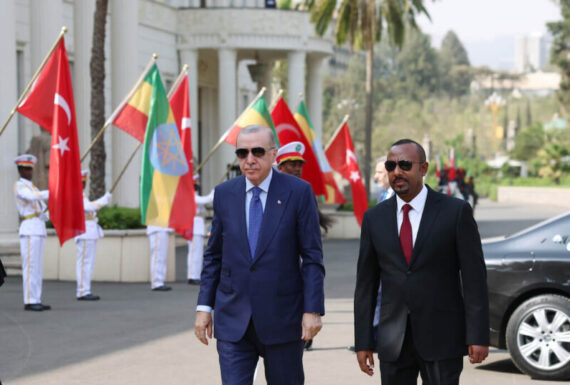
hen Turkish President Recep Tayyip Erdoğan says he does not want to see “a new conflict in the Horn of Africa,” he is not making a throwaway remark about a distant region. He is speaking after high-level talks in Addis Ababa and phone calls that range from Abu Dhabi to Mogadishu, at a moment when Red Sea tensions, Ethiopia’s search for sea access and Somalia’s first offshore drilling project are all converging. I don’t read this as a routine diplomatic line. To me, it is a sign that, for Ankara, stability from Ethiopia to Somalia has become a strategic test of its broader foreign policy narrative.
Over the last few years, Türkiye has steadily expanded its footprint along the Red Sea–Gulf of Aden corridor. Somalia hosts Turkish trainers, engineers and aid workers. Ethiopia has become one of Ankara’s largest investment destinations on the continent. Sudan, Djibouti and even Eritrea now enter Turkish debates about sea lanes, energy routes and security risks. Erdoğan’s latest message simply makes explicit what policy choices have already been saying quietly: the Horn of Africa is no longer a side file.
That matters because the region sits at the intersection of several fires at once. Civil war in Sudan, unresolved tensions inside Ethiopia, maritime insecurity in the Red Sea and the persistent threat of al-Shabaab in Somalia all blur into one another. For a country that sees itself as both a regional stabilizer and a rising middle power, ignoring this arc of instability is not really an option.
Türkiye’s entry point into the Horn of Africa was Somalia. What began as humanitarian aid during the 2011 famine turned into a long-term relationship that combines military training, infrastructure projects, and political support. Ankara built roads, hospitals and schools in Mogadishu, opened an embassy when many others stayed away and later established a major military training base to support Somali forces fighting al-Shabaab.
Over time, this “Somalia file” stopped being just about one fragile state. Turkish diplomats and security officials increasingly framed it as part of a wider picture that stretches from the Suez Canal to the Indian Ocean. Turkish Airlines routes, port projects and naval deployments all reflect the same logic: what happens around the Bab el-Mandeb strait and the Gulf of Aden directly affect Türkiye’s trade, energy security and diaspora connections.
As Ethiopia’s leadership began to talk more openly about its need for sea access, and as Sudan’s war threatened to fragment another coastal state, Ankara’s calculus shifted again. It was no longer enough to work only with Mogadishu. Relations with Addis Ababa deepened around investment, defense cooperation and discussions on how Ethiopia could secure access to ports without triggering a wider conflict. The message coming out of Erdoğan’s meetings has been consistent: any solution on sea access should be based on regional consensus, not unilateral moves that risk pulling everyone into a crisis.
This is happening in a crowded field. The United States, Gulf countries, Egypt, the European Union and China all have their own military bases, port concessions and political projects in and around the Horn. Türkiye is not the biggest player in terms of money or firepower. Its difference lies in what it is not: it has no colonial history in the region; it presents itself as a partner from the Global South and it speaks the language of both security and development at the same time.
Erdoğan’s Horn of Africa message is rooted in very concrete security concerns. Ethiopia is still managing the aftershocks of internal conflicts. Sudan’s civil war threatens to spill over into Chad, South Sudan, and the Red Sea. Eritrea remains a closed but influential actor. In Somalia, al-Shabaab has not disappeared, even as security forces have made gains. Across the water, Yemen’s conflict and Houthi attacks on shipping lanes have turned the Red Sea into a zone of permanent alert.
In such an environment, escalation rarely stays local. A border clash between Ethiopia and a coastal neighbor, a miscalculation in Sudan or a major attack on shipping could quickly draw in Gulf states, Western navies and regional rivals. Trade routes, energy flows and migration patterns would all feel the shock.
Türkiye’s answer has been to invest in local capacity rather than posture as a front-line power. In Somalia, Turkish officers train army and police units, while naval forces contribute to anti-piracy and maritime security missions. The aim is to help local institutions stand on their feet, not to replace them. The same logic applies to Ethiopia and Sudan, where Ankara stresses respect for territorial integrity and advocates political dialogue even as it supplies equipment and technical support.
From Ankara’s perspective, stability in the Horn is tied directly to its own security. New refugee flows, disrupted shipping in the Red Sea, or the spread of extremist networks would quickly reach the Eastern Mediterranean and beyond. At the same time, a more stable Horn offers opportunities: safer trade corridors, energy cooperation with Somalia, and a friendlier environment for Turkish investment in Ethiopia and Sudan.
Security is only part of the equation. The Horn of Africa has also become an economic and diplomatic laboratory for Türkiye. Turkish companies are active in ports, construction and logistics projects, seeking a role in upgrading infrastructure that links landlocked states to global markets. Every port concession, every logistics hub has a dual meaning: commercial opportunity and geopolitical leverage.
For a middle power with limited resources, every naval mission, every training base and every trade deal has to serve more than one purpose. A presence in Mogadishu is not only about counterterrorism; it is also about giving Turkish firms a foothold in a market that others have long ignored. Investment in Ethiopian manufacturing is not only about cheap labor; it supports a political partnership that Ankara hopes will last through leadership changes on both sides.
Soft power runs alongside these hard interests. Scholarship programs bring Ethiopian and Somali students to Turkish universities. Development agencies support health, education and agriculture projects in remote areas. Turkish NGOs operate clinics and schools that often outlast news cycles. In quiet times, these efforts build goodwill. In moments of crisis, they provide channels to actors who do not always sit at official tables.
Recommended
All of this gives Ankara a certain mediation capital. Turkish officials can speak to leaders in Addis Ababa, Mogadishu, Khartoum, Riyadh and Cairo without starting from zero. Recent rapprochement with Egypt and deeper coordination with Saudi Arabia on Sudan and Red Sea security show how Türkiye is trying to turn potential rivals into partners when interests overlap.
Yet the constraints are real. Budgetary pressures and domestic politics limit how much energy Ankara can devote to every crisis at once. The more files it opens – from Ukraine and Gaza to Libya, the South Caucasus and the Sahel – the more questions arise about whether its capacity matches its ambitions. In the Horn of Africa, where so many actors already operate, any misstep risks being amplified.
That is why Erdoğan’s call for stability should be read as more than a slogan. It is effectively a statement of self-interest. If conflict escalates around Ethiopia’s search for sea access, if Sudan’s war further fragments the Red Sea coast, or if Somalia’s offshore energy projects become another axis of rivalry, Türkiye’s investments – political, economic and military – will all be at risk.
The Horn of Africa will show whether Ankara can translate its narrative of partnership and mediation into sustained crisis management on the ground. Keeping channels open from Addis Ababa to Mogadishu while avoiding zero-sum rivalries with other external powers will not be easy. It means working quietly with Gulf states when interests align, pushing back when local actors try to drag external partners into their own proxy games, and accepting that some efforts will fail.
If Ankara manages that balance, the Horn may become one of the regions where its middle-power diplomacy proves its worth: a place where a mix of security cooperation, economic engagement and soft power actually reduces risk rather than exporting it. If not, the gap between rhetoric and delivery will show up here very quickly – and not only Türkiye, but the wider region, will pay the price.

Göktuğ ÇALIŞKAN is a PhD candidate at the International University of Rabat (UIR) in Morocco, conducting research as a scholar of the Turkish Ministry of National Education (YLSY program). Simultaneously, he serves as an International Relations Specialist at ANKASAM. He holds undergraduate degrees in Political Science and Public Administration (Ankara Yıldırım Beyazıt University) and Law (Erciyes University). He completed his master’s studies at Ankara Hacı Bayram Veli University and UIR (in French). His analyses on global politics and security have been featured in various international outlets, including Türkiye Today, Daily Sabah, TRT Afrika, and FokusPlus.
You can see how this popup was set up in our step-by-step guide: https://wppopupmaker.com/guides/auto-opening-announcement-popups/

Stay informed by subscribing to
our weekly newsletter.
You can see how this popup was set up in our step-by-step guide: https://wppopupmaker.com/guides/auto-opening-announcement-popups/
You can see how this popup was set up in our step-by-step guide: https://wppopupmaker.com/guides/auto-opening-announcement-popups/
You can see how this popup was set up in our step-by-step guide: https://wppopupmaker.com/guides/auto-opening-announcement-popups/
You can see how this popup was set up in our step-by-step guide: https://wppopupmaker.com/guides/auto-opening-announcement-popups/