Protests and Tension in Iran: What’s for the Region?

January 27, 2026

The Iranian regime is facing another shaking due to the price of its dreams of regional power, its failure to implement comprehensive reforms and achieve economic development and its collapsing militia network.
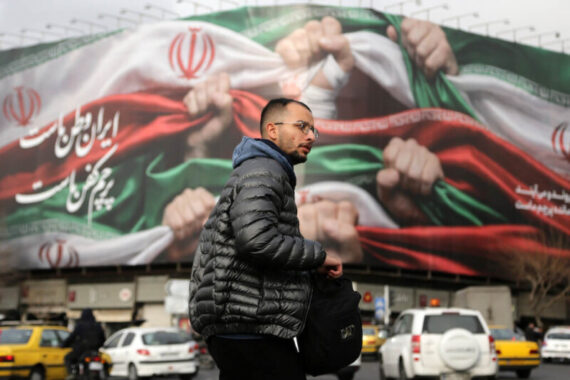
A view of giant banner, featuring an image of the Iranian flag and the slogan reading 'Iran is our homeland, the flag is our shroud' at Enghelab Square in the capital Tehran, Iran on January 15, 2026. Photo by Anadolu Images.

S

ince December 28, Iran has been at a historic turning point, with the regime in Tehran shaken by large-scale public protests and uprisings. According to some experts, the slogans chanted at the protests resemble those used during the 1979 Revolution and the 2011 Arab Spring. Therefore, while the Tehran regime is struggling to suppress the protests, which are partly driven by opposition to the regime, they also carry economic, social, and political dynamics. Although President Pezeshkian announced that measures had been taken and promises had been made regarding economic reforms, the increasing size of the protests shows that these promises have had no effect on the public.

Furthermore, U.S. President Trump’s mention of military intervention in Iran, using these demonstrations as a pretext, and Netanyahu’s statement that he is closely monitoring the events and not refraining from provoking the U.S. on this issue indicates that the situation is heading in a dangerous direction.

Iran’s current problems and resulting protests should not be viewed as isolated events. They must be analyzed in the context of Iran’s historical, cultural, economic, and socio-political dynamics. While the mass movements that led to the overthrow of the Shah regime and Western domination of the country’s energy resources remain in Iran’s social memory, the same triggers that led to the street movements in 1979 have recurred, contributing to the current situation.

Therefore, we must seek answers to why “economic fragility” and “regime legitimacy” remain unchanged in Iranian politics and social structures despite the rule of different political systems (the Shah and the mullah regime) and why these two issues have been at the center of problems for years. Similarly, while the merchant and middle classes played an important role in the uprising during the Shah’s reign, today, it is the merchant class—which we call the “market”—and vulnerable population segments that have ignited the protests.


Is this an Iranian spring?

However, the people’s complaints about harsh living conditions and President Pezeşkiyan’s statement, “Where am I going to get dollars for this country?” during today’s protests are reminiscent of the slogans that emerged during the 2011 Arab Spring (“bread,” “honor,” “freedom”) and the expressions of discontent from people suffering under harsh living conditions in North African countries such as Egypt and Tunisia. This raises the question: Is this an Iranian spring?

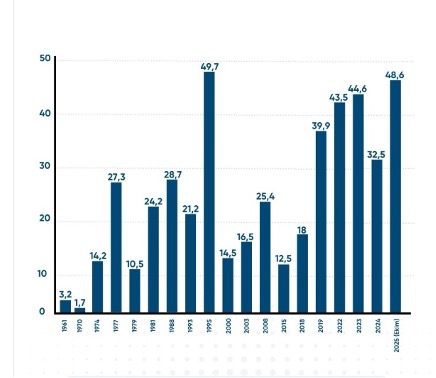
During this time, the Iranian rial suffered a historic devaluation. As can be seen in Figure 1 below, protests triggered by inflation exceeding 40% annually are intensifying day by day. Meanwhile, the rhetoric of the Tel Aviv–Washington alliance, which is closely following the events, has adopted a threatening tone aimed at pressuring the Iranian regime. Indeed, U.S. President Trump referred to the events in Iran in his statement, saying, “Iran is looking at freedom perhaps more than it has ever looked at freedom before. I tell the Iranian leaders, ‘You better not fire because we will start firing.’”

Figure-1: The Inflation rates in Iran between 1961-2025 World Bank, 2025

The economic cost of flawed foreign policy

The Iranian regime viewed the social and political revolutionary movements of the “Arab Spring,” which began in late 2010, as an “Islamic Awakening.” Obsessed with becoming a regional power, the regime established a broad militia network stretching from Lebanon to Iraq and from Syria to Yemen. It sought to consolidate regime security and emerge as the dominant power in a Middle East where balances were shifting and security architecture was being reshaped. In geopolitical power competition with other major regional actors, such as Turkey, Israel, Saudi Arabia, and Egypt, Iran has pursued a revisionist agenda within the framework of its policy of exporting revolution.

This agenda has been costly for the Iranian regime; the costs of the struggle on the ground have not been sufficient to cover them. The Assad regime in Damascus suffered a major defeat at the hands of the opposition and was overthrown on December 8, 2024. Meanwhile, the Lebanese Hezbollah, representing Tehran’s “Octopus Doctrine,” collapsed as well. This doctrine is represented by groups such as the Lebanese Hezbollah and Ansarullah (Houthis), which had spread across the region (Syria, Iraq, Yemen).

These regional initiatives provoked a reaction from the Iranian people, who asked, “Why are our billions of dollars being spent in Syria?” Ultimately, Tehran suffered a major defeat with the collapse of the Assad/Baath regime in Damascus. Tehran had shifted from exporting the regime to protecting it and had prepared $400 billion worth of projects through Syria.

The multifaceted problems of the Iranian regime

Similar to the events of 1979, the participation of young people, bazaar workers, women, and mullahs in street protests, coupled with widespread social involvement, positions the current demonstrations as a potential turning point in Iran’s history. The influence of socio-political and socio-economic dynamics and the fragile relationship between the regime and the public, built on years of deep mistrust, are among the main factors that summarize the current situation in Iran.

It is an indisputable fact that the population within the country does not live in harmony with the regime, in addition to the 8-10 million Iranians living outside Iran today. The Iranian regime is facing another shaking due to the heavy price of its dreams of regional power, its failure to implement comprehensive reforms and achieve economic development, its collapsing militia network, failed projects and investments, the severe destruction and devastation caused by the “12-Day War” with Israel, the pressure of international sanctions, and its misguided agricultural and water policies.

The Middle East, which has been grappling with instability stemming from the Arab Spring for over a decade, will struggle to close the rift that Iran, a major political actor, will create in the region’s security architecture. Iran’s descent into a situation of fragmentation and instability similar to that of Iraq after the 2003 U.S. intervention will create new geopolitical fractures and produce social and political fault lines that will have a lasting impact for many years. Although the US and Israel probably aim to establish an Iranian regime similar to that which existed before 1979 under the leadership of former Iranian prince Reza Pahlavi, with whom they have good relations, this plan carries risks that have not been considered in a balancing situation that includes these regional and global actors.

Mehmet Babacan completed his PhD in 2025 at Bursa Uludag University with a thesis on Jerusalem and Palestine studies. He works as an independent researcher. He has various national and international publications about Turkish foreign policy, Palestine/Israel, US Middle East policy, and other regional foreign policy issues. Babacan has also served as a “Researcher” in YOK (Council of Higher Education) and EU projects.