Radar Bases Linked to US THAAD Systems Hit in Jordan, Saudi Arabia and UAE

March 9, 2026

Images analyzed from multiple military installations in Jordan, Saudi Arabia, United Arab Emirates, and Qatar suggest that facilities associated with the high-end Terminal High Altitude Area Defense (THAAD) system were targeted in strikes.
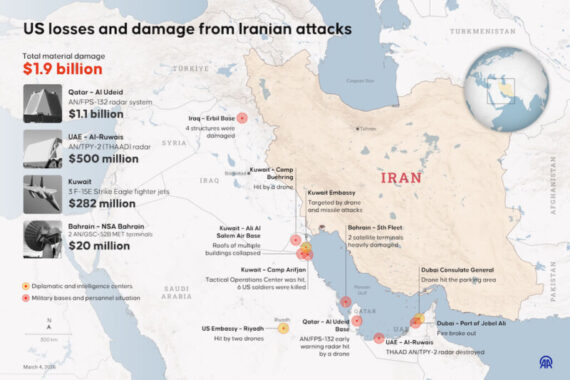
An infographic titled 'US losses and damage from Iranian attacks' created in Ankara, Turkiye on March 4, 2026. Photo by Anadolu Images.

S

atellite imagery indicates that radar systems linked to advanced missile defense networks used by the United States and its regional allies were struck in several Middle Eastern countries during the early days of the ongoing conflict with Iran.

Images analyzed from multiple military installations in Jordan, Saudi Arabia, United Arab Emirates, and Qatar suggest that facilities associated with the high-end Terminal High Altitude Area Defense (THAAD) system were targeted in strikes that appear aimed at degrading air-defense capabilities across the Arabian Peninsula.

Military analysts say the attacks may represent a coordinated effort to disrupt the region’s integrated missile defense network, which is designed to detect and intercept ballistic missiles and drones before they reach their targets.

Radar destroyed at Jordan base

One of the most significant strikes appears to have occurred at Muwaffaq Salti Air Base, a key hub for U.S. military operations in the region.

Satellite images taken on March 2 show debris and burn marks surrounding a radar unit belonging to a THAAD battery stationed at the base. Two large craters, each roughly four meters across, can be seen near the equipment, suggesting multiple impacts.

The radar system involved is believed to be the AN/TPY-2 Radar, a highly sophisticated missile detection system manufactured by Raytheon. The radar plays a central role in THAAD operations by detecting incoming threats and guiding interceptor missiles toward their targets.

According to U.S. defense budget documents, a single AN/TPY-2 radar costs close to $500 million. The system is typically mounted across several large transport trailers and can track ballistic missiles at long distances.

Images indicate that multiple components of the radar system at Muwaffaq Salti were either destroyed or severely damaged.

Prior satellite imagery taken before the start of hostilities showed heavy military activity at the base. More than 50 fighter jets were visible on the tarmac, along with drones and transport aircraft. Several aircraft shelters, likely containing additional planes, were also present at the installation.


Damage reported near Saudi base

Another site showing possible strike damage is located near Prince Sultan Air Base, a major facility hosting American aircraft and personnel.

Satellite images captured on March 1 show smoke rising from a compound where a radar shelter associated with a THAAD battery had previously been located. The tent-like structure used to house the radar antenna appears badly charred, and debris is scattered across the surrounding area.

Earlier images from January showed the radar antenna positioned inside the shelter and oriented northeast, toward Iran.

It remains unclear whether the radar was present at the site at the time of the strike or whether the equipment belonged to the U.S. military or to Saudi Arabia’s own THAAD system.

Saudi officials have not publicly commented on the incident, while U.S. defense officials have declined to discuss the status of specific capabilities in the region, citing operational security.

UAE and Qatar installations also hit

Satellite imagery also shows damage at two military installations in the United Arab Emirates: one near Al Ruwais and another near Al Sader.

At the Ruwais site, at least three buildings appear to have been struck between February 28 and March 1. Among the damaged structures are pull-through vehicle sheds commonly used to store radar components for THAAD batteries.

A similar pattern of damage was observed at the Sader installation, where four buildings show signs of impact.

Analysis of earlier satellite imagery indicates that both locations have hosted THAAD batteries and associated radar systems for several years. However, it remains unclear whether radar equipment was present inside the buildings at the time of the strikes.

Separate imagery also indicates damage to a U.S.-made early-warning radar system located at Umm Dahal in Qatar.

The radar, part of a broader regional missile detection network, helps provide early warning of incoming ballistic missiles and shares data with allied defense systems.

Experts say disabling such sensors could reduce the effectiveness of missile interception by limiting detection time and coordination among air defense systems.

Strategic effort to weaken defenses

Defense specialists say the apparent focus on radar installations suggests a strategy aimed at disrupting the region’s missile defense infrastructure rather than simply striking aircraft or runways.

“The AN-TPY-2 radar is essentially the heart of the THAAD battery,” said N.R. Jenzen-Jones, director of the research group Armament Research Services. “Without the radar, the system loses much of its ability to detect and track incoming ballistic missiles.”

While damaging the radar does not render the THAAD system completely inoperable, it significantly reduces its effectiveness and flexibility, analysts say.

Replacement radars would likely need to be redeployed from other regions, a process that could take considerable time and logistical effort.

THAAD batteries are designed to work in conjunction with other air defense systems, including the MIM-104 Patriot missile defense system, forming layered protection against a variety of aerial threats.

Continuing drone and missile attacks

The strikes come amid continued missile and drone attacks targeting Gulf countries hosting U.S. forces.

Authorities in the United Arab Emirates reported that the number of ballistic missiles launched toward the country has decreased since the first days of the conflict, dropping from 137 on the opening day to seven later in the week.

However, drone attacks have continued at a steady pace and now account for most of the aerial threats facing the country.

Since the start of hostilities, the UAE says it has faced more than 1,000 drone attacks and nearly 200 ballistic missiles.

The country hosts American forces at several bases, including Al Dhafra Air Base, making it one of the most heavily targeted states in the region.

Pentagon officials declined to comment on the status of specific radar systems but acknowledged that operations in the region remain ongoing.

(Source: CNN)

Politics Today is dedicated to publishing insightful analyses in order to understand the changing nature of contemporary politics. It aims to contribute to the sound and constructive discussion of international affairs.