Anwar's Taiwan Remarks Reignite Debate Over Malaysia's Non-Aligned Stance
Taiwan's government, however, warned that Anwar's "one-sided support for China could negatively impact Taiwanese businesses' confidence in investing in Malaysia."
August 26, 2026
M
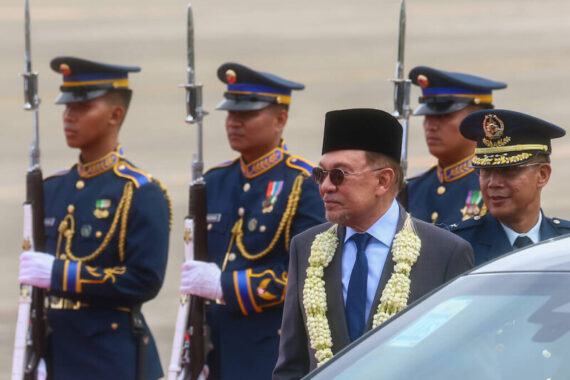
alaysian Prime Minister Anwar Ibrahim’s recent comments on Taiwan have intensified scrutiny over whether the Southeast Asian nation is drifting from its long-held policy of non-alignment and tilting toward Beijing amid intensifying US-China rivalry.
In an interview with Al Jazeera aired earlier this month, Anwar stated unequivocally that he viewed Taiwan “as part of China, period,” adding that this position was “accepted by all.” The remarks drew immediate praise from Beijing and sharp condemnation from Taipei, while reigniting debate among analysts and diplomats about Malaysia’s strategic orientation.
When pressed on whether he would condemn China if it resorted to military force should peaceful reunification fail, Anwar drew a controversial parallel to his own country’s territorial integrity. If a Malaysian state attempted to secede, he said, he would use force to “protect the sanctity and unity of” Malaysia.
China’s Ministry of Foreign Affairs welcomed the comments, with a spokesman reiterating that Taiwan is “an inalienable part of China’s territory” and that “China must and will be reunited.”
Taiwan’s government, however, warned that Anwar’s “one-sided support for China could negatively impact Taiwanese businesses’ confidence in investing in Malaysia.” The self-governing island, the world’s leading semiconductor producer, remains a major investor in Malaysia’s critical chip manufacturing sector.
Facing questions from local media in the days following the interview, Anwar appeared to soften his stance, emphasizing that Malaysia respected China’s position but favored a peaceful resolution to tensions across the Taiwan Strait.
The apparent recalibration did little to quell speculation about Malaysia’s geopolitical leanings, particularly after Anwar courted further headlines by calling for strengthened defenses in the Bornean state of Sabah. He cited the development of US-backed military facilities in neighboring Philippines as partial justification for increased defense spending.
The Philippine government is upgrading military installations on the island of Balabac, located just 50 kilometers from the Malaysian islands of Banggi and Balambangan. Balabac was recently added to the Enhanced Defense Cooperation Agreement between Washington and Manila, granting US forces access to designated locations across the Philippines.
Anwar’s remarks have reinforced longstanding suspicions among Western observers that Malaysia is breaking from its traditional non-aligned posture and aligning more closely with China. The country has become one of the most enthusiastic recipients of Chinese investment under Beijing’s Belt and Road Initiative, and China now represents Malaysia’s largest trading partner.
Malaysia has also diverged sharply from Western positions on other geopolitical issues, most notably the ongoing conflict in the Middle East. Long a vocal critic of Israel, Malaysia under Anwar has been especially outspoken in its opposition to Israel’s war on Gaza.
Some analysts, however, caution against reading Anwar’s comments as evidence of a strategic realignment.
Chee Meng Tan, an assistant professor of business economics at the University of Nottingham Malaysia, noted that Malaysia’s recognition of Taiwan as part of China dates back to the 1974 communiqué signed by then-Prime Minister Tun Abdul Razak and Chinese Premier Zhou Enlai establishing diplomatic relations between the two countries.
“What was new was Anwar’s statement on the potential use of force, which the One China policy does not explicitly require,” Tan said, suggesting the remarks should be viewed in the context of Anwar’s scheduled visit to China in September.
Anwar’s comments on the US-backed base in Balabac are also connected to Malaysia’s long-running territorial dispute with the Philippines over Sabah. Manila has claimed the territory since it joined Malaysia in 1963, a claim Kuala Lumpur has consistently rejected.
The Philippines reaffirmed its claim to Sabah in February, maintaining that its Maritime Zones Act 2024 preserved “existing and valid claims” over part of the state. In July, Malaysia lodged a formal protest with the United Nations over the Philippines’ claim to an extended continental shelf that Malaysia argued encroached on Sabahan waters.
Tan suggested that Anwar’s comments on the Balabac military buildup may represent “a ‘protect-my-border’ reflex rather than a pro-China gesture.”
Anwar’s call to bolster Sabah’s defenses also comes as Malaysia seeks to strengthen its military posture in Borneo, partly to reinforce its claims in the disputed South China Sea, where Malaysia is a claimant state alongside China, Vietnam, the Philippines, and Brunei.
While Malaysia has adopted a less confrontational stance on the South China Sea dispute than the Philippines, it has maintained robust defense ties with Western powers as a quiet counterweight to China’s military buildup in the contested waters.
This is exemplified by Malaysia’s continued commitment to the Five Powers Defence Arrangements, a multilateral security framework that also includes Singapore, Australia, New Zealand, and the United Kingdom. While not a binding defense treaty, the arrangement commits members to consult in the event of an armed attack on Malaysia or Singapore.
Under the framework, annual military exercises involving personnel and assets from member countries are conducted. The arrangement maintains an air defense operations headquarters at a Malaysian Air Force base in Butterworth, Penang, headed by a senior Australian Air Force officer. Australia also maintains a rifle company in Butterworth and regular maritime patrol aircraft deployments to Malaysia.
As a central pillar of the arrangement, Malaysia facilitates a Western military presence in the region that analysts say provides a quiet deterrent against potential aggressors.
Recommended
While Malaysia recognizes the benefits of continued defense ties with the West, it also derives significant economic advantages from Western investment and trade relationships.
“Malaysia has maintained diverse economic relations with many states, and this has kept it from deeply aligning with any major power,” Loebell said, expressing skepticism that Malaysia is seeking closer alignment with China.
“The USA still maintains as favourable an economic position as China does,” he added. “What’s more, Taiwan’s enterprises continue to invest heavily in Malaysia’s semiconductor industry, and Anwar undoubtedly knows and welcomes this.”
As Anwar prepares for his upcoming visit to China, his remarks on Taiwan appear to have been carefully calibrated to signal solidarity with Beijing while preserving Malaysia’s room for maneuver. Whether this balancing act can be sustained amid intensifying great power competition remains an open question for Malaysian foreign policy.
(Source: Aljazeera English)

Politics Today is dedicated to publishing insightful analyses in order to understand the changing nature of contemporary politics. It aims to contribute to the sound and constructive discussion of international affairs.
You can see how this popup was set up in our step-by-step guide: https://wppopupmaker.com/guides/auto-opening-announcement-popups/

Stay informed by subscribing to
our weekly newsletter.
You can see how this popup was set up in our step-by-step guide: https://wppopupmaker.com/guides/auto-opening-announcement-popups/
You can see how this popup was set up in our step-by-step guide: https://wppopupmaker.com/guides/auto-opening-announcement-popups/
You can see how this popup was set up in our step-by-step guide: https://wppopupmaker.com/guides/auto-opening-announcement-popups/
You can see how this popup was set up in our step-by-step guide: https://wppopupmaker.com/guides/auto-opening-announcement-popups/