Erdoğan: Dialogue Channels with Greece Must Remain Open
Erdoğan said that he “sincerely believes” Türkiye and Greece should keep dialogue channels open on the basis of cooperation as two neighbors and NATO allies.
February 12, 2026
T
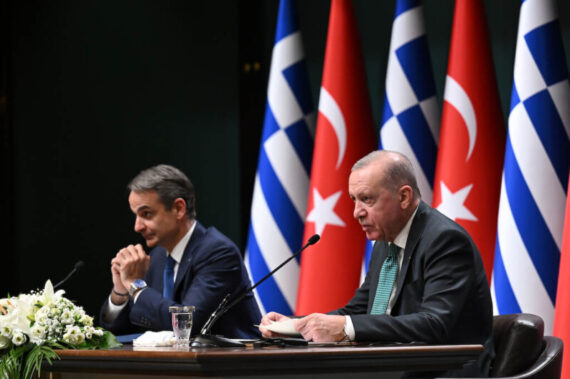
urkish President Recep Tayyip Erdoğan said Wednesday that he “sincerely believes” Türkiye and Greece should keep dialogue channels open on the basis of cooperation as two neighbors and NATO allies.
Erdoğan spoke at a joint news conference in Ankara with Greek Prime Minister Kyriakos Mitsotakis following their talks held within the framework of the 6th meeting of the High-Level Cooperation Council.
Erdoğan said they once again discussed their positions on the Aegean and the Eastern Mediterranean in an open and frank manner.
“Although the existing issues are complicated, they are not unsolvable within the framework of international law. What is needed is goodwill, constructive dialogue and the will to reach a solution,” he said, adding that he was pleased to see that he and Mitsotakis shared a similar understanding.
The Turkish president recalled his visit to Athens on December 7, 2023, when both sides registered their commitment to maintaining dialogue and improving relations through the Athens Declaration. He said the leaders reviewed how to advance ties further through a positive agenda.
Erdoğan expressed hope that the documents signed during the visit would strengthen the contractual basis of bilateral relations.
He noted that the two countries continue to work toward their goal of increasing bilateral trade from nearly $7 billion last year to $10 billion. Business councils from both sides also met to explore new opportunities, he added.
Erdoğan said he also conveyed Türkiye’s expectations regarding the fight against terrorism and organized crime.
“We must act with a sense of historical responsibility regarding minorities, which constitute the human dimension of our relations,” he said. Erdoğan reiterated expectations that the Turkish minority in Western Thrace should fully benefit from religious freedoms and educational opportunities.
The two leaders also discussed regional issues, including Gaza and Syria.
Erdoğan said Türkiye rejects Israel’s recent decisions aimed at expanding control in the West Bank and weakening the Palestinian administration. He stressed that lasting peace and stability in the Middle East can only be achieved through a just two-state solution.
He voiced hope that Greece, as a non-permanent member of the UN Security Council for 2025-2026, would keep the two-state perspective on the council’s agenda.
On Syria, Erdoğan underlined the importance of stability and preserving the country’s territorial integrity, adding that Türkiye’s constructive role contributes not only to Syria but also to the security of Greece and Europe.
“As two neighbors and allies, I sincerely believe we must keep dialogue channels open with an understanding based on cooperation,” he said.
Mitsotakis thanked Erdoğan for the hospitality and said the meetings in Ankara demonstrated how valuable dialogue and good neighborly relations are.
He recalled that in 2023 the two sides made a strategic choice to develop contacts based on political dialogue, a positive agenda and confidence-building measures.
“Through open channels of communication, we had the opportunity to address the issues between us,” he said, adding that Greece remains committed to continuing cooperation in good faith and mutual respect.
Mitsotakis said cooperation with Türkiye on irregular migration had been very productive, noting a 60% decrease in illegal migration in 2026.
He also praised the short-term visa scheme that enabled hundreds of thousands of Turkish citizens to visit Greek islands, saying it helped bring the two peoples closer. Athens will work with the European Union to continue the practice, he added.
The Greek prime minister reiterated the shared objective of reaching $10 billion in trade volume and said infrastructure upgrades at border crossings would support that aim. He also welcomed mutual investments by companies from both countries.
Mitsotakis acknowledged that differences remain, including over the continental shelf and exclusive economic zones in the Aegean.
“These issues could perhaps be referred to an international judicial body. Within the framework of international law, solutions can be found,” he said, expressing optimism that the conditions are right for progress.
Recommended
Referring to Cyprus, Mitsotakis said Greece’s position is clear and that any renewed process should be based on UN Security Council resolutions.
On Western Thrace, he said Greece recognizes a Muslim religious minority under the Treaty of Lausanne and stressed that minorities in both countries can serve as bridges of understanding.
Mitsotakis said Greece consistently supports a two-state solution and believes the Palestinian side must be included in future governance, while also underlining the need for Hamas to be disarmed.
“We do not support any possible step toward Israel’s annexation of Gaza,” he added, noting that settlement expansion makes the creation of a Palestinian state more difficult.
Saying that destiny has made Türkiye and Greece “residents of the same neighborhood,” Mitsotakis emphasized that the geography cannot change but cooperation can be strengthened.
He invited Erdoğan to Greece for the next High-Level Cooperation Council meeting.
Following the talks, Erdoğan hosted a closed-door dinner in honor of Mitsotakis at the presidential complex.
(Source: Anadolu Agency)

Politics Today is dedicated to publishing insightful analyses in order to understand the changing nature of contemporary politics. It aims to contribute to the sound and constructive discussion of international affairs.
You can see how this popup was set up in our step-by-step guide: https://wppopupmaker.com/guides/auto-opening-announcement-popups/

Stay informed by subscribing to
our weekly newsletter.
You can see how this popup was set up in our step-by-step guide: https://wppopupmaker.com/guides/auto-opening-announcement-popups/
You can see how this popup was set up in our step-by-step guide: https://wppopupmaker.com/guides/auto-opening-announcement-popups/
You can see how this popup was set up in our step-by-step guide: https://wppopupmaker.com/guides/auto-opening-announcement-popups/
You can see how this popup was set up in our step-by-step guide: https://wppopupmaker.com/guides/auto-opening-announcement-popups/