From Astana to Turkistan: Decoding Erdoğan’s Middle Corridor Vision
Turkey is not simply a transit country on the Middle Corridor. It is the corridor’s European gateway.
June 3, 2026
O
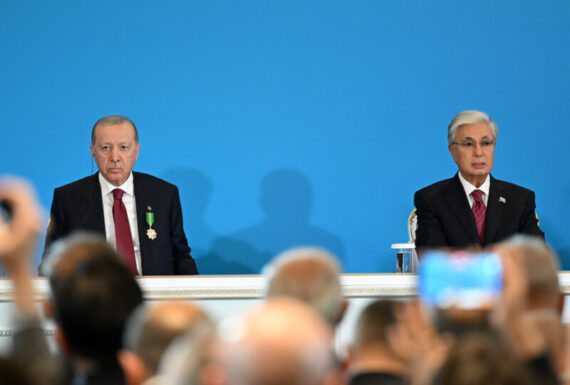
n May 13, in Astana’s Palace of Independence, Recep Tayyip Erdoğan and Kassym-Jomart Tokayev stood before cameras and announced what they called an “eternal friendship declaration”, a phrase that sounds ceremonial until you read the fine print. Bilateral trade exceeding $5 billion, around 3,800 Turkish companies operating on Kazakh soil, a $15 billion trade target set as the new horizon, and, cutting across all of it, the Middle Corridor. Not as background noise, but as the explicit spine of the entire visit.
Two days later, in the ancient city of Turkistan, the Organization of Turkic States held its informal leaders’ summit under the theme of artificial intelligence and digital development. Erdoğan, addressing the gathering, went beyond the official agenda. He connected the Iranian crisis in the Strait of Hormuz directly to the urgency of the Middle Corridor, a land-and-sea route stretching from China across Kazakhstan, the Caspian, Azerbaijan, Georgia, and into Turkey before reaching European markets. The logic was blunt: when maritime arteries choke, overland corridors breathe.
That argument is no longer speculative. It is, increasingly, a fact confirmed by freight data, political decisions, and the quiet repositioning of powers that prefer not to make headlines.
The Trans-Caspian corridor carried 4.5 million tons of cargo in 2025, up fivefold from the 800,000 tons recorded just seven years ago. Container traffic along the route grew 36% in 2025 alone. Kazakhstan, which handles 85% of the freight flowing through this corridor, now aims to push that figure to 10 million tons. Rail cargo between Ankara and Astana rose 35% this year. Delivery times on the route have already been cut from 28-32 days to 13-17 days, and there is still room to compress them further.
These are not projections dressed up as achievements. They reflect a structural shift that began quietly after 2022, when the war in Ukraine made the northern Russia-bound routes functionally untenable for many European and Asian shippers. The Middle Corridor absorbed that displacement. Turkey sat at the western end of that displacement, and it knew it.
Turkey is not simply a transit country on the Middle Corridor. It is the corridor’s European gateway. Every container that moves from Kazakhstan across the Caspian, through Azerbaijan and Georgia, must pass through Turkish territory before reaching European markets, whether by rail through Edirne or by sea from Istanbul and Mersin. Turkish ports handled a record 553 million tons of cargo in 2025. That record did not emerge from thin air. It reflects years of investment in port capacity, rail connectivity, and customs infrastructure.
The Baku-Tbilisi-Kars railway, the iron thread connecting Central Asia to Turkey’s rail network, remains still underutilized relative to its potential. Capacity expansion has lagged behind demand. There are bottlenecks. Anyone who follows this sector knows that the Kars junction is one of them. Erdoğan’s Astana statements signaled awareness of this, yet the speed of institutional follow-through remains the actual variable in the equation.
What Turkey brings to the corridor, beyond geography, is institutional leverage. Ankara sits inside NATO, maintains active trade relations with the European Union, and holds the presidency of the Organization of Turkic States for the coming period. That combination, Western institutional membership paired with Turkic world leadership, gives Turkey a bridging function that no other country on the corridor can replicate. Kazakhstan cannot speak to Brussels the way Ankara can. Brussels cannot speak to Astana the way Ankara can. That is not a minor advantage; it is the corridor’s political operating system.
The informal summit in Turkistan produced, on its surface, communiqués about artificial intelligence, digital infrastructure, and joint language models. Uzbekistan proposed what its delegation called a “Digital Turkic Corridor”, a fibre optic and data centre network mirroring the physical trade route. These are not trivial ambitions. A digital corridor that piggybacks on a physical one creates compounding returns: shared data sovereignty, reduced dependency on non-Turkic tech infrastructure, and a political narrative of self-sufficiency that resonates across the region.
For Turkey, the digital corridor proposal is both an opening and a quiet pressure. Istanbul already functions as one of the most significant internet exchange points between Europe, the Middle East and Central Asia. If a unified Turkic digital infrastructure takes shape, and Turkey helps define its architecture, the strategic weight of Turkish territory compounds further. Should Ankara move decisively, that architecture will be shaped on Turkish terms, not by outside players already embedded in the region. The Turkestan summit named the ambition. Whether Turkish institutions can match it with speed will be one of the defining questions heading into the formal OTS summit this autumn.
Yet the political subtext of the Turkistan summit deserves as much attention as its official agenda. Tokayev’s statement, publicly opposing any military dimension for the OTS, was a counterweight to Turkey’s offer to share its defense industry experience with Turkic states
That exchange, which received far less media attention than the signing ceremonies, exposes the OTS’s central unresolved question: Is this organization a civilizational platform, a trade bloc, or the embryo of something with harder edges? Astana, balancing its northern and eastern dependencies with Russia and China, prefers the answer to remain vague. Ankara would not mind a slightly sharper answer.
This is not a crisis. It is a negotiation, one that will run through the 13th formal OTS summit in Turkey this autumn, and well beyond it.
Recommended
There is a reason why Western analysts have started watching the Middle Corridor with less condescension and more attention. The World Bank projects that freight volumes along the route could triple to 11 million tons by 2030. The European Union, facing the consequences of its own supply chain fragility, has been quietly upgrading its engagement with Trans-Caspian infrastructure. China’s Belt and Road Initiative, for all its ambitions, faces growing political resistance in Europe; a corridor that does not carry Beijing’s brand is structurally preferable.
Turkey understands this. Erdoğan’s return flight remarks, describing NATO as “not the NATO of the old world”, were partly about Turkey’s ambitions for the Ankara NATO summit in July 2026. But they were also, indirectly, about Turkey’s pitch: we are a corridor country, a bridge country, a country whose geography cannot be replaced. That pitch works on Western audiences precisely because the Middle Corridor is not a Chinese project, not a Russian project, and not a project that requires alignment with any single power. It requires alignment with Turkey.
The Hormuz argument Erdoğan made in Turkistan, that energy routes dependent on a single chokepoint are inherently fragile, applies equally to Europe’s own import dependencies. Pipelines crossing Turkey already carry Azerbaijani gas westward. The corridor can carry more, and different things, and faster than it does today.
If the infrastructure investment keeps pace with the political narrative, Turkey will not merely be a participant in the Eurasian transit race. It will be the one setting the terms.

Göktuğ ÇALIŞKAN is a PhD candidate at the International University of Rabat (UIR) in Morocco, conducting research as a scholar of the Turkish Ministry of National Education (YLSY program). Simultaneously, he serves as an International Relations Specialist at ANKASAM. He holds undergraduate degrees in Political Science and Public Administration (Ankara Yıldırım Beyazıt University) and Law (Erciyes University). He completed his master’s studies at Ankara Hacı Bayram Veli University and UIR (in French). His analyses on global politics and security have been featured in various international outlets, including Türkiye Today, Daily Sabah, TRT Afrika, and FokusPlus.
You can see how this popup was set up in our step-by-step guide: https://wppopupmaker.com/guides/auto-opening-announcement-popups/

Stay informed by subscribing to
our weekly newsletter.
You can see how this popup was set up in our step-by-step guide: https://wppopupmaker.com/guides/auto-opening-announcement-popups/
You can see how this popup was set up in our step-by-step guide: https://wppopupmaker.com/guides/auto-opening-announcement-popups/
You can see how this popup was set up in our step-by-step guide: https://wppopupmaker.com/guides/auto-opening-announcement-popups/
You can see how this popup was set up in our step-by-step guide: https://wppopupmaker.com/guides/auto-opening-announcement-popups/