Iran Broadens Economic Pressure Campaign in Bid to Force U.S. Concessions

August 4, 2026

After demonstrating its ability to disrupt maritime traffic through the Strait of Hormuz, Iran has signaled that its pressure campaign could extend well beyond the strategic chokepoint.
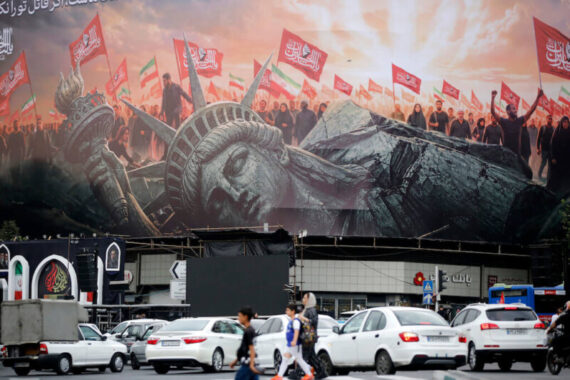
A massive anti-U.S. banner was hung in Tehran, the capital of Iran. The banner, hung in Revolution Square in the capital, read in Farsi: “Why shouldn’t we kill the person who killed our Imam? If we do not kill our Imam’s murderer, it will be a disgrace for us.” Photo by Anadolu Images.

I

ran is increasingly relying on economic disruption rather than direct military confrontation to pressure the United States into making concessions over the Strait of Hormuz, expanding threats to regional shipping routes and energy infrastructure as the conflict enters a prolonged phase.

According to Gulf officials, regional sources and analysts, Tehran believes that sustained pressure on global trade and energy markets will prove more effective than conventional military escalation in forcing Washington to reconsider its position.

Rather than seeking a decisive battlefield victory, Iran has adopted a strategy of calibrated escalation designed to steadily raise the economic and political costs of the conflict while avoiding an all-out regional war. The objective, analysts say, is to convince the United States and its allies that accommodating Iran’s demands over the Strait of Hormuz is less costly than continuing the current confrontation.

“Iran, from the beginning, has tried to out-escalate the United States by stretching out its escalation options so that it always has something new to bring every week — a new geography, a new type of weapon, a new type of target,” Michael Knights of the Washington Institute told Reuters.

He argued that Iran’s greatest leverage lies not in its ability to inflict military damage on the United States or Israel, but in its capacity to disrupt regional economies and global commerce.

“The bigger advantage they have is not that they can hurt America or Israel,” Knights said. “Their big advantage is that they can hurt the regional states and the global economy.”

Pressure beyond Hormuz

After demonstrating its ability to disrupt maritime traffic through the Strait of Hormuz — a waterway that carried around one-fifth of global oil consumption before the conflict — Iran has signaled that its pressure campaign could extend well beyond the strategic chokepoint.

Threats directed at the Red Sea and Saudi energy infrastructure suggest Tehran is seeking to widen the geographical scope of the crisis, increasing the cost of protecting international shipping while testing Washington’s willingness to sustain a prolonged confrontation.

One Gulf source said commanders in Iran’s Revolutionary Guards believe recent developments have strengthened Tehran’s negotiating position.

“The Iranians believe that by widening the war and increasing the pressure, he will eventually give in,” the source said, referring to U.S. President Donald Trump. “Trump thinks he can hit the Iranians hard and bring them to the negotiating table, but they won’t bend.”

That assessment has shaped Tehran’s negotiating strategy, according to Iranian and regional sources.

Trump said on Monday that negotiations with Iran would take place after he canceled a planned military strike in hopes of securing an agreement to reopen the Strait of Hormuz. Iranian officials, however, denied that talks with Washington were currently underway.

A senior Iranian source said Tehran’s leadership has concluded that previous attempts at flexibility only encouraged greater pressure from Washington, reinforcing the belief that meaningful negotiations can occur only after Iran establishes stronger leverage.

In Tehran’s view, the source said, Trump interprets concessions as weakness and responds only to sustained pressure.

Michael Singh, another senior fellow at the Washington Institute, said Iranian leaders appear convinced they still hold the initiative because the Trump administration remains uncertain about how far it is willing to escalate militarily.

“The Iranians are trying to press their advantage,” Singh said. “They’re interested in establishing sovereignty over the strait and exercising selective control over the waterway.”

Dispute over the Strait

At the heart of the standoff is the future administration of the Strait of Hormuz, one of the world’s most strategically important maritime corridors.

Regional sources say Oman has presented Tehran with a Gulf-backed proposal that would establish a mechanism for managing shipping through the strait, including voluntary user fees.

Iran, however, is reportedly seeking administrative authority over the waterway and the right to impose service charges on vessels passing through it.

Washington has rejected any arrangement that would allow Iran to exercise control over the strait, insisting it must remain an international waterway open to unrestricted commercial navigation.

Former U.S. diplomat Alan Eyre said Iran’s broader strategy is intended to deter further American military action while forcing Washington to lift its naval blockade and reconsider its negotiating position.

“They don’t want the U.S. to dictate the pace of events,” Eyre said.

War of endurance

Analysts say Iran’s campaign has already shifted the focus of regional and international efforts.

Rather than intensifying military pressure on Tehran, Gulf states and Western governments are increasingly concentrating on protecting commercial shipping and critical energy infrastructure.

The formation of a Saudi-led maritime coalition reflects that shift. According to Gulf sources, the initiative is primarily defensive, focusing on escorting commercial vessels, sharing intelligence and safeguarding vital sea lanes instead of confronting Iran directly.

Knights compared the effort to Europe’s Aspides naval mission in the Red Sea, which was established to protect merchant shipping rather than alter the regional military balance.

For Tehran, forcing rivals into an expensive defensive posture represents a strategic success despite its military disadvantages.

Unable to match U.S. military capabilities directly, Iran can still impose significant costs by compelling regional governments and foreign navies to devote increasing resources to securing global trade routes.

Each new threat, whether in the Strait of Hormuz, the Bab al-Mandeb Strait or elsewhere, increases the financial and military burden of keeping international commerce flowing.

Analysts describe the conflict as increasingly becoming a contest of endurance.

Iranian leaders appear to believe they can withstand economic pressure longer than the United States and its partners can tolerate repeated disruptions to global energy supplies and maritime trade.

The strategy also serves a diplomatic purpose.

By demonstrating an ability to expand the crisis whenever necessary, Tehran hopes to strengthen its bargaining position before any future negotiations.

“If there are going to be negotiations, they will define the terms,” said Ray Takeyh of the Council on Foreign Relations. “Both sides are matching escalation with escalation.”

Despite intermittent diplomatic efforts, neither Washington nor Tehran has shown signs of backing down.

As both sides continue to test each other’s resolve through economic pressure, military deterrence and political signaling, analysts warn that a strategy intended to maximize leverage could still spiral into a wider conflict that neither side intends or is fully able to control.

(Source: Reuters)

Politics Today is dedicated to publishing insightful analyses in order to understand the changing nature of contemporary politics. It aims to contribute to the sound and constructive discussion of international affairs.