
Steel Dome and Strategic Air Defense
Steel Dome is a defense umbrella and the product of technological and strategic vision for Turkey.
September 5, 2025
T
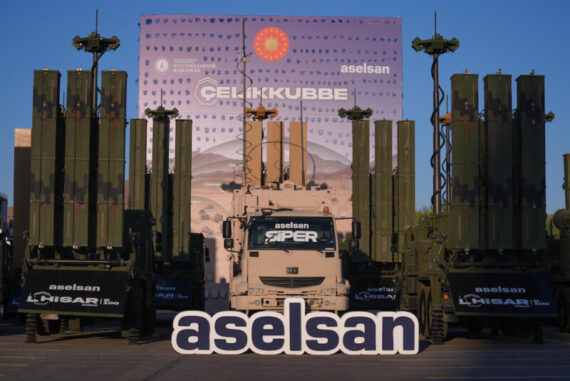
he Steel Dome project is a testament to Turkey’s vision in the field of air defense. It is a system architecture that will adapt to the future battlefield. With its multilayered structure, command and control infrastructure supported by artificial intelligence, and sensor, weapon, and communication systems developed entirely with domestic resources, Steel Dome is a defense umbrella and the product of technological and strategic vision.
Two critical events that occurred in June 2025 offered valuable insights into the evolving role of air power in modern warfare and its strategic implications. First, on June 1, Ukraine launched simultaneous unmanned aerial vehicle (UAV) attacks on several air bases in Russia. Then, on June 13, Israel launched a large-scale, coordinated air campaign targeting Iran’s nuclear program and military infrastructure. Iran subsequently retaliated against Israeli territory with ballistic missiles and kamikaze drones. Noteworthy in both incidents were not only the technical characteristics of the air platforms used but also how these platforms were integrated with intelligence, electronic warfare, and command-and-control systems.
These developments have produced consequences that must be considered at the operational, strategic, technological, and doctrinal levels. Furthermore, the fact that these events occurred in regions bordering Turkey underscores the need to assess these threat dynamics not only theoretically but also geographically, from Turkey’s national security perspective. In this context, Turkey’s efforts to develop its own air and missile defense systems are crucial for advancing defense technology, achieving strategic autonomy, and promoting regional stability.
In this context, the Steel Dome project stands out as a system architecture that embodies Turkey’s vision in the field of air defense and will adapt to the future battlefield. Announced to the public at the Defense Industry Executive Committee (SSİK) meeting on August 6, 2024, Steel Dome is a project that will serve as a defense umbrella. With its multi-layered structure, command and control infrastructure supported by artificial intelligence, and sensor, weapon, and communication systems developed entirely with domestic and national resources, the Steel Dome project is a defense umbrella and a product of technological and strategic vision.
Following the August 6, 2024 meeting of the Defense Industry Executive Committee (SSİK), the project was announced to the public. Steel Dome is essentially the name of the structure that will be formed by bringing together early warning, command and control, communication, and weapon systems for Turkey’s air and missile defense.
The statement issued regarding the meeting summarized the project’s three key dimensions: a multi-layered structure; an artificial intelligence–supported command and control infrastructure; and a national system focus. These dimensions are a multi-layered structure, an AI-supported command and control infrastructure, and a national system focus. This statement summarizes the project’s three key dimensions. As a “system of systems,” Steel Dome’s architecture reflects the interwoven layers of air defense.
In order to explain the three fundamental characteristics of the Steel Dome, it is necessary to examine the main threats in modern air warfare.
Fixed-wing aircraft: Military fixed-wing aircraft are used for many different missions. Their basic mission types include air-to-air combat, attacking ground targets, transporting logistics, reconnaissance and surveillance, providing airborne early warning and command and control, and conducting electronic warfare. These mission differences highlight specific performance criteria in aircraft design. For instance, fighter aircraft developed for air superiority prioritize high speed, maneuverability, and climb capability. Conversely, aircraft designed for close air support missions must be resistant to enemy fire and have high survivability. Heavy transport aircraft, in contrast, are designed to fly at high altitudes at a constant speed, so high maneuverability is not necessary.
Rotary-wing aircraft (helicopters): Used for various tasks such as transport, reconnaissance, and attack, helicopters mostly fly close to the ground at low to medium speeds. Depending on their type and design, they can be highly maneuverable and agile, though medium and heavy transport helicopters are generally more cumbersome. Attack helicopters are designed to operate at low altitudes and relatively high speeds. One significant advantage of modern attack helicopters is their ability to neutralize targets with precision-guided munitions without being detected.
Unmanned aerial vehicles (UAVs): Thanks to technological advances, a wide range of UAVs are being produced and used, from hand-launched FPV (first-person view) drones controlled with virtual reality goggles to jet-powered strategic reconnaissance and intelligence aircraft that can stay airborne for over 24 hours. These UAVs can be remotely controlled and can fly partially or fully autonomously. Those developed for military use are widely used in missions such as reconnaissance, surveillance, attack, and electronic warfare. As demonstrated by Turkey’s Bayraktar TB2 and Anka UAVs, they can have a significant impact on the battlefield. Almost all tactical and operational class UAVs in widespread use have piston or turboprop engines, long endurance, and much smaller fuselages than manned combat aircraft.
Cruise missiles: These are guided munitions that fly straight to their targets like an aircraft. They usually fly at low altitudes and autonomously correct their course with the help of their guidance and control systems. Various guidance and navigation technologies are used for precision targeting. Most cruise missiles in widespread production and use are jet-powered and have subsonic flight speeds. However, supersonic and hypersonic cruise missiles (traveling at speeds of at least five times the speed of sound) have also begun to proliferate in recent years.
Kamikaze Drones: These drones, which are a transitional form between unmanned aerial vehicles (UAVs) and cruise missiles, have been in production since the 1980s. They came to public attention during the Russia-Ukraine War when Russia used Iranian-made Shahed 136s. Initial models flew straight toward a pre-programmed target. However, subsequent versions gained the ability to change speed, altitude, and course; loiter in the target area; and receive target updates from the ground. Due to their small size and low speed, these drones are difficult for air defense sensors and weapon systems designed for combat aircraft or missiles to track and destroy. They have caused significant damage to Ukraine’s energy infrastructure in particular.
Ballistic missiles: These long-range weapons follow a ballistic trajectory after launch to reach their target. They gain thrust with the speed they achieve during launch, and after this stage, the engine shuts down and the missile enters the free flight phase. This section is defined as the “midcourse.” Then, the missile enters a steep dive toward the target in the final approach phase, called the “terminal phase.” If the missile has an advanced guidance system, it can make minor trajectory corrections during this phase. Due to the high speed at this point, the kinetic energy is high enough to cause serious destruction to the target.
Advances in materials, electronics, sensors, and software technologies have enhanced the capabilities and performance of the aforementioned air threats, enabling them to undertake new missions. For instance, unmanned aerial vehicles (UAVs), originally developed for reconnaissance and surveillance, were first armed for precision strikes. Now, UAVs equipped with sophisticated sensors are being used for electronic warfare and airborne early warning missions.
These air threats have different flight altitudes, speeds, maneuverability, range, and coverage areas of their weapon systems and sensors. This underscores the fact that a comprehensive early warning and defense system against air threats must consist of interlocking layers.
This multi-layered structure is also at the core of the Steel Dome’s “system of systems” approach.
Ballistic Missiles: These long-range weapons follow a ballistic trajectory after launch to reach their target. They gain thrust with the speed achieved during launch, and after this stage, the engine shuts down and the missile enters the free flight phase. This section is defined as the “midcourse,” after which the missile enters a steep dive toward the target in the final approach phase.
The Hisar family of air defense missile systems, developed jointly by ASELSAN and ROKETSAN, covers low and medium altitudes. As of 2021, the Hisar-A+ (low altitude) and Hisar-O+ (medium altitude) systems have reached the serial production and inventory entry stage. The Hisar-A+ consists of radar and electro-optical sensors mounted on an ACV 30 tracked armored vehicle chassis produced by FNSS and four vertical launchers that fire infrared-guided missiles with a 15-kilometer range. The system provides defense against low-altitude UAVs, cruise missiles, and helicopters. The Hisar-O+ is a medium-altitude solution mounted on a tactical wheeled vehicle with a 25-kilometer range.
The Hisar family also includes a derivative called the Hisar-D RF, which was developed for use on combat ships. These missiles are carried and fired by the National Vertical Launch System (MİDLAS), which was developed by ROKETSAN for use on ships. They will contribute to the air defense capabilities of national warships, beginning with the İstif class.
Developed by ASELSAN, ROKETSAN, and TÜBİTAK SAGE, Siper is designed to defend strategic infrastructure, bases, and facilities from air attacks. It will be the cornerstone of Turkey’s air defense system thanks to its active radar-guided missiles, advanced command and control infrastructure, and radar capable of detecting, identifying, and tracking targets from long distances. At the Grand National Assembly of Turkey’s Planning and Budget Commission, where the Ministry of National Defense’s 2025 budget was discussed, Minister of National Defense Yaşar Güler provided information on the subject. He stated that the first missile of the system, the “Siper Product 1” missile, has a range of 100 kilometers and has entered service.
Güler also stated that development and testing activities are ongoing for the Siper Product 2, which has a range of 150 kilometers, and the Siper Product 3, which has a range of 180 kilometers.
The Hisar family includes a derivative called the Hisar-D RF, which was developed for combat ships. These missiles are carried and fired by the National Vertical Launch System (MİDLAS), developed by ROKETSAN for use on ships. The Hisar-D RF will contribute to the air defense capabilities of national warships, beginning with the İstif class.
The aforementioned air defense weapon systems receive airspace and target data from ASELSAN’s Alp series of early warning radars and Kalkan series of air defense radars. The Hakim Air Command and Control System is the backbone of this entire network structure. Launched by ASELSAN in March 2020, Hakim is a C4I (command, control, communications, computers, and information) system designed to provide full integration between all command and control centers at the strategic, operational, and tactical levels of the Turkish Air Force Command. Hakim can also create a “joint picture” using sensor data from land and sea forces. It is compatible with the NATO ACCS (Air Command and Control System) architecture and can exchange air pictures with allied countries when necessary.
Hakim’s architecture allows for the real-time tracking of all air traffic in Turkey and its surrounding airspace. It can detect and identify potential threats from a long range using different sensors and prevent these threats using the most appropriate weapon systems. Thanks to its flexible and modular design, the system can also integrate new sensors, weapons, and platforms as they enter the inventory of the Turkish Armed Forces. This feature enables Turkey to develop military-strategic cooperation with its allies through interoperability.
Steel Dome is Turkey’s response to the rapidly changing and evolving nature of air threats. Various solutions and projects are being implemented around the world in this regard. As was evident in the recent Iran-Israel war, ballistic missiles in particular have highlighted the heavy burden placed on modern air defense architectures.
Israel’s air defense system is layered and integrated to protect against short-, medium-, and long-range threats. Iron Dome supports short-range threats, David’s Sling supports medium-range threats, and Arrow 2, Arrow 3, and the U.S.-made THAAD systems support long-range threats. These systems are supported by an extensive radar network, electronic intelligence systems, and advanced command and control infrastructure. They also work in full integration with US assets in the region.
The Arrow system is based on a 1986 memorandum of understanding with the United States. The first Arrow system was developed with a Green Pine radar with a 1,500-kilometer range and a two-stage structure. It provided basic ballistic missile defense capabilities. Arrow 1 was replaced by Arrow 2, a lighter and more advanced version that began development in the mid-1990s. The Arrow 2 system is integrated into a two-layer defense concept designed to work with Patriot PAC systems, particularly against high-altitude ballistic threats. Arrow 2 has a maximum detection range of 500 kilometers and an interception range of up to 90 kilometers.
The most advanced member of the Arrow family, the Arrow 3, can intercept targets in space, i.e., outside the atmosphere. Operating on the “hit-to-kill” principle, this missile destroys its target with kinetic energy alone, as it does not carry a warhead. The system underwent its first test in 2015 and officially entered service in 2017.
Starting on June 13, this structure destroyed some of the ballistic missiles fired by Iran, but it was unable to prevent important bases and facilities in Tel Aviv and Haifa from being struck. While there is no reliable, verifiable data on interception success rates, a significant amount of footage of successful interceptions outside the atmosphere has appeared in open sources.
Launched in October 2022 under German leadership, the European Sky Shield Initiative (ESSI) is a regional air and missile defense initiative involving 24 European countries. The initiative aims to establish a land-based, multi-layered defense umbrella across Europe based on joint procurement and integrated use principles. The primary objectives are to strengthen Europe’s defense capabilities against Russia’s ballistic, cruise, and hypersonic missile threats and contribute to NATO’s Integrated Air and Missile Defense (IAMD) network.
The ESSI comprises four layers, including short-, medium-, long-, and very long-range sensor and weapon systems. The weapon systems include: Skyranger 30, which is used against short-range targets, primarily drones and small targets; IRIS-T SLM, which is used against medium-range unmanned aerial vehicles and cruise missiles; MIM-104 Patriot, which is used for long-range air defense; and Arrow 3, which is used to protect against ballistic missiles outside the atmosphere, up to 100+ kilometers away. The IRIS-T SLM system is supported by the TRML 4D radar, the Patriot PAC-3 MSE system by the LTAMDS radar, and the Arrow 3 system by the EL/M 2080 Green Pine radar. Thanks to this multilayered structure, the missile defense portfolio provides comprehensive coverage of flight profiles and target types.
In February 2024, Turkey joined the ESSI, adding geographical depth and strategic contributions to the initiative. Turkey’s participation expands the initiative’s scope and depth while enhancing its technological cooperation and joint doctrine development capabilities. It also strengthens Turkey’s military-strategic network within NATO and enables it to contribute integrated defense systems to Europe’s defense industry infrastructure.
Recommended

In today’s increasingly complex security environment, air and missile defense has become one of the most critical strategic needs for countries. However, meeting this need presents an extremely challenging technological and cost-related undertaking. The broad and dynamic spectrum of threats—ranging from ballistic missiles and kamikaze drones to cruise missiles and hypersonic systems—necessitates developing different sensor, weapon, and command-and-control solutions for elements with varying altitudes, speeds, and maneuverability characteristics.
This makes air defense expensive and technically complex. Therefore, it is impossible to create an “unbreakable” air defense system; even the most advanced systems can be vulnerable to leaks, breaches, and failures. Israel’s struggle against Iranian missiles demonstrates this fact, despite allocating enormous resources to air defense for decades and having the backing of the U.S.’s almost unlimited, unconditional technological support.
However, these challenges do not negate the necessity of air defense. In fact, these systems are indispensable for strategic deterrence, crisis management, and force protection during wartime. A modern state can only effectively control its airspace with a comprehensive early warning, command and control, and integrated response system—not just fighter jets and radars. In this context, Turkey’s Steel Dome architecture, which is currently under development, is more than just a defense system. It also demonstrates the level of Turkey’s national defense technology and its commitment to strategic autonomy.
Steel Dome offers a flexible, multi-layered, and integrated solution against various threats with the Hisar missile family, the Siper long-range system, the Korkut artillery system, modern radars, and the Hakim command and control infrastructure. Developed with domestic capabilities, this system will reduce Turkey’s dependence on foreign countries for defense while ensuring interoperability with allied countries. The system is important not only for military purposes, but also for protecting strategic targets, such as energy infrastructure, cities, and base areas. It is also important to emphasize that this project showcases the expertise and sophistication of the Turkish defense industry.
Finally, air defense is not only a defensive capability, but also sends a strategic message. Considering Turkey’s geographical location and its threatening surroundings, possessing such a capability is fundamental to national security. In this regard, the Steel Dome has the flexibility and technological foundation to respond to current threats and the future landscape of warfare. Therefore, this system represents a technological leap in the defense industry and a deterrent threshold in military strategy.
(Originally published in Turkish by Kriter)

Arda Mevlutoglu holds a BSc degree (Hons) in Astronautical Engineering from Istanbul Technical University and a MS degree in Science and Technology Policy Studies from Middle East Technical University. His research focuses on aerospace and defense technologies, defense policies, and regional security issues.
You can see how this popup was set up in our step-by-step guide: https://wppopupmaker.com/guides/auto-opening-announcement-popups/

Stay informed by subscribing to
our weekly newsletter.
You can see how this popup was set up in our step-by-step guide: https://wppopupmaker.com/guides/auto-opening-announcement-popups/
You can see how this popup was set up in our step-by-step guide: https://wppopupmaker.com/guides/auto-opening-announcement-popups/
You can see how this popup was set up in our step-by-step guide: https://wppopupmaker.com/guides/auto-opening-announcement-popups/
You can see how this popup was set up in our step-by-step guide: https://wppopupmaker.com/guides/auto-opening-announcement-popups/