Ukrainian Drones Strike Moscow Refinery Again, Bringing War to Russia's Capital

June 19, 2026

President Volodymyr Zelenskyy reportedly highlighted Ukraine's deep-strike capabilities during meetings with U.S. President Donald Trump and other leaders at the recent Group of Seven summit in France.
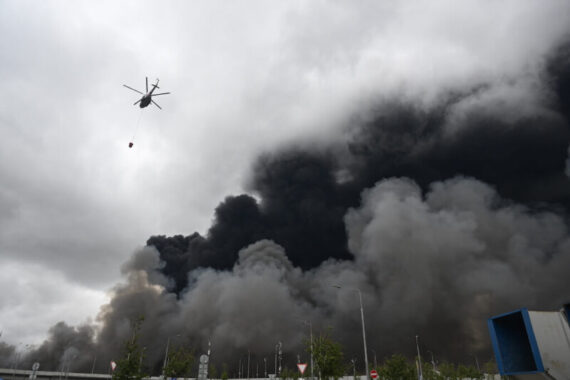
A firefighting helicopter is carrying water as black smoke billows from the area of Gazprom Neft’s Moscow oil refinery, located on the southeastern outskirts of Moscow, on June 18, 2026. Photo by Anadolu Images.

U

krainian drones struck a major oil refinery in southeast Moscow for the second time in three days on Thursday, triggering a massive fire, disrupting transportation across the Russian capital, and underscoring Kyiv’s growing ability to carry the war deep inside Russian territory.

The attack targeted one of Moscow’s key fuel-processing facilities, located just 16 kilometers (10 miles) from the Kremlin and within the city’s ring road, making it one of the most symbolically significant strikes on Russian infrastructure since the war began more than four years ago.

Video footage shared on social media showed thick black smoke billowing into the sky above the refinery after a powerful explosion. Witnesses reported that the blast was so intense that the giant metal lid of an oil storage tank was hurled into the air.

The strike appeared to evade Russian air defenses and ignited a blaze that emergency crews battled for hours.

War reaches the heart of Russia

The attack forms part of a broader Ukrainian campaign targeting Russia’s energy sector, which Kyiv argues provides crucial revenue for Moscow’s military operations in Ukraine.

But beyond the economic impact, the strike carried substantial symbolic significance.

By successfully targeting infrastructure inside the Russian capital, Ukraine appears intent on demonstrating to ordinary Russians that the consequences of the war are no longer confined to distant battlefields.

Ukraine’s Foreign Minister, Andrii Sybiha, used social media to directly address residents of Moscow following the attack.

“One of the most popular questions asked by Muscovites this morning is ‘What is going on?'” Sybiha wrote. “Your country started a war of aggression against ours. For years, it has been killing our people.”

The comments reflected Kyiv’s effort to frame the attacks as a response to Russia’s invasion rather than an escalation of the conflict.

Disruption across Moscow

The strike caused widespread disruption throughout the Russian capital, home to more than 13 million people.

Authorities temporarily suspended flights at all Moscow airports as security services assessed the threat posed by additional drones.

Operations were halted at Sheremetyevo Airport, Russia’s busiest air hub, and parts of the airport were evacuated as a precaution.

Traffic was also disrupted along major roads surrounding the refinery, creating significant delays for commuters.

Residents in online forums complained that no air raid sirens or emergency alerts were issued before the attack.

Some suburban residents reported finding oily residue on vehicles and windows after rainfall passed through areas affected by smoke from the refinery fire.

The incident highlighted the growing vulnerability of Russia’s largest city to long-range Ukrainian drone operations.

While Moscow has experienced occasional drone attacks since 2023, including an incident involving the Kremlin itself, such strikes have generally had limited impact on daily life.

Thursday’s attack represented one of the most disruptive incidents the capital has experienced since the conflict began.


Economic impact growing

The latest refinery strike also points to the increasing economic consequences of Ukraine’s campaign against Russia’s energy infrastructure.

Russia remains one of the world’s largest oil producers and a major exporter of crude oil and refined fuel products.

Repeated attacks on refineries, storage facilities, and transportation networks have begun affecting domestic fuel supplies.

Industry sources told Reuters that Russia is expected to import fuel by sea this month, an unusual step for a country that is normally a major fuel exporter.

Reports of gasoline shortages have emerged in several regions in recent weeks.

Although Moscow city authorities insisted that fuel supplies in and around the capital remain stable, Russia’s federal anti-monopoly service has launched an inquiry after one major retailer reportedly increased gasoline prices by nearly 19 percent within a week.

Energy analysts say sustained attacks on refining capacity could place additional pressure on domestic fuel markets while increasing operational costs for Russia’s economy.

Competing narratives

The strike comes as both Moscow and Kyiv seek to shape international perceptions of the war’s trajectory.

Ukrainian officials argue that successful long-range attacks demonstrate Russia’s inability to fully protect critical infrastructure and prove that Ukraine retains the capacity to inflict meaningful damage despite years of fighting.

President Volodymyr Zelenskyy reportedly highlighted Ukraine’s deep-strike capabilities during meetings with U.S. President Donald Trump and other leaders at the recent Group of Seven summit in France.

Russian officials, however, rejected suggestions that the battlefield balance is shifting.

A Kremlin aide said Thursday that reports of Ukrainian momentum were misleading and accused Western leaders of promoting unrealistic assessments of the conflict.

President Vladimir Putin did not publicly comment on the refinery attack. He was attending a summit with Southeast Asian leaders in Kazan at the time of the incident.

Debate inside Russia

The attack also sparked debate among Russian commentators regarding public access to images and information about strikes inside the country.

Videos showing flames and smoke rising above Moscow spread rapidly online and were widely shared by both Ukrainian and Russian social media users.

Some pro-government commentators argued that such footage assists Ukraine by providing valuable information about strike effectiveness.

Russian television host and pro-Kremlin blogger Andrei Medvedev called for legal action against individuals posting videos of the attack.

“A few days ago, some idiots filmed and posted the video, and the enemy watched it, assessed it, and adjusted the next strike,” he wrote on Telegram.

The comments reflect growing concerns among Russian authorities that social media is undermining efforts to control information about the war’s impact on the home front.

Symbolic victory for Kyiv

For Ukraine, the latest strike represents more than a military operation against energy infrastructure.

The ability to hit a strategic target located only miles from the Kremlin sends a powerful message that Russia’s capital is no longer insulated from the consequences of the conflict.

As Kyiv continues its campaign against Russia’s energy industry, analysts say such attacks are intended not only to disrupt military financing but also to challenge perceptions of security inside Russia itself.

Whether those attacks can alter the broader course of the war remains uncertain, but Thursday’s dramatic strike ensured that the realities of the conflict were once again visible in the heart of Moscow.

(Source: Reuters)

Politics Today is dedicated to publishing insightful analyses in order to understand the changing nature of contemporary politics. It aims to contribute to the sound and constructive discussion of international affairs.