India-Russia Ties Are Rock Solid but Challenging and Risky
The India-Russia relationship is no longer the blind friendship of the Soviet era.
January 14, 2026
R
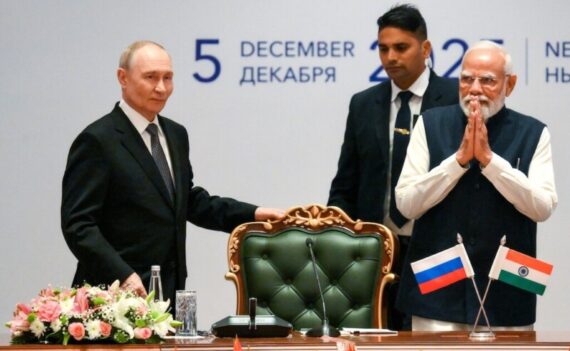
ussian President Vladimir Putin visited India for the 23rd annual Russia-India summit on December 4-5, after a four-year absence. His visit signaled that the two countries’ fundamental national interests remain aligned as the global order shifts. India relies on Russia for defense equipment and affordable energy, while Russia needs a reliable economic and strategic partner outside the West. The most important takeaway from the visit was that the relationship between the two countries is strategic, not merely transactional, despite global turbulence.
Putin’s visit coincided with a challenging period for both countries. For Delhi, 2025 was the most challenging year in terms of foreign policy. The four-day conflict between India and Pakistan in May marked the worst period of hostility between the two countries in a long time. During Donald Trump’s second term as US president, he accused India of purchasing Russian crude oil, causing a sudden and sharp decline in India-US relations. Trump’s summit with Putin in Alaska signaled a strategic realignment of US policy aimed at repairing Washington’s frayed ties with Moscow. However, Trump’s overall stance is inconsistent. Moscow is dissatisfied with Washington due to its inconsistent support for Ukraine.
Due to their current problems with the US since Trump’s second term, both countries are turning to each other. India-Russia relations are strengthened by reliable arms supply and energy access, which serve as a buffer against isolation and Chinese dominance. However, expecting Russia to help India resolve its border disputes with China would be too much to ask of Russia. However, India’s ties with Russia are forcing the US to offer better terms, and Russia’s interaction with the US is forcing it to keep India as a partner.
Putin’s visit confirmed that maintaining Delhi’s strategic autonomy requires keeping all channels open. It also sent a clear signal that India and Russia are strong allies. Turbulence in India-U.S. relations, caused by Trump’s pressure tactics, led Delhi to realize that it was not indispensable. Ultimately, Prime Minister Narendra Modi misread India’s influence on the global stage, a fact that both Trump and Chinese President Xi made clear.
Let’s start by listening to what Modi said when he first came to power, despite often being criticized in India as pro-US:
“If you ask any of the more than one billion people living in India who our country’s greatest friend is, everyone knows it’s Russia. India’s ties with Russia are incomparable. Since 1947, India-Russia relations have been the only constant in a rapidly changing world. They have stood the test of time and grown stronger. The resilience of our relationship is based on the principles of equality, trust, and mutual benefit.”
Throughout the 1960s and 1970s, geopolitical pressure from the United States, China, and Pakistan kept India away from the West, led by the United States, and steered it toward closer relations with the Soviet Union. The Peace, Friendship, and Cooperation Treaty, signed in 1971, established a foundation of trust between the two countries. Throughout the 1970s and 1980s, close trade partnerships and strategic ties were further strengthened.
The India-Soviet Union rapprochement, whose foundations were firmly laid during that period, continues to manifest itself in India-Russia relations today. Although Delhi displays a closer stance toward the US today, its deep-rooted ties with Moscow remain important as a “balancing alternative.” China’s assertiveness and Washington’s unpredictability make Moscow an important factor in India’s calculations.
During the Cold War, India emerged as the leader of the Non-Aligned Movement. At the same time, however, India sought to develop a “special relationship” with the Soviet Union. Incidentally, the nonalignment policy itself was problematic because members of the Non-Aligned Movement were tied to the superpower blocs to some extent. As bilateral relations developed, the Soviets became an “irreplaceable counterbalancing force” in addressing India’s regional and international concerns.
The Soviets remained India’s largest trading partner until the collapse of the Soviet Union. Their material and technical support formed the basis of many local industries in India. They provided India with all military production lines, from aircraft to tanks, and played a significant role in developing the Indian Navy. Mindful of the balance between the U.S. and China, the Soviet Union focused on strengthening India’s military capabilities (and Russia still does today).
Although intense interactions in bilateral relations were disrupted during the first decade after the Cold War ended and the Soviet Union collapsed, the foundation of trust and friendship established during that time continued. Relations with the Russian Federation after the Cold War were restructured. Moscow’s primary motivation was and remains the pursuit of multipolarity. Moscow proposes creating a “strategic triangle” among India, Russia, and China to stabilize international security and effectively counterbalance the unipolarity led by the U.S. after the Cold War. However, the lack of trust between Delhi and Beijing hinders this goal. Nevertheless, the quest for multipolarity spearheaded by Moscow remains common ground among the three countries.
India-Russia relations grew closer when Vladimir Putin became president in 2000, and the two countries upgraded their relationship from a strategic partnership to a special and privileged strategic partnership in 2010. The most important pillar of bilateral relations is defense cooperation, and Russia is a “proven and tested” partner in this regard. Moscow provides Delhi with advanced defense equipment and sensitive military technologies. Russia is also the only country with which India has an institutionalized mechanism for high-tech transfer and joint production. Civil nuclear cooperation is particularly important; Russia is currently the only country building nuclear power plants in India.
However, India is concerned about Russia’s strategic coordination with China and its growing closeness to Pakistan. Moscow’s stance toward Beijing and Islamabad could lead to a new test of trust in its relations with Delhi. In the past, the Soviet Union was India’s primary supplier of arms, economic partner, and political supporter. Article 9 of the 1971 agreement provided India with a security umbrella against the U.S., China, and Pakistan.
After the collapse of the Soviet Union in 1991, Article 9 was abolished, and India-Russia relations became more normal and less guaranteed. Putin rebuilt the “special strategic partnership” label and has maintained strong defense ties for 25 years. The Indian armed forces remain heavily reliant on inexpensive, reliable, and powerful Russian weapons. However, the war in Ukraine has weakened Russia, brought it closer to China, and complicated India’s relations with the West. Delhi is now caught between needing Russian weapons and oil and needing Western support against Beijing. In a sense, Putin’s December visit was aimed at striking this balance and avoiding being crushed by sanctions or Russia’s war.
Delhi’s enduring relationship with Russia is based on three critical pillars. First, defense has always formed the bedrock of the bilateral relationship. Despite Delhi’s recent efforts toward diversification and indigenous production, Moscow remains India’s primary military hardware supplier. Approximately 60-70 percent of India’s current military inventory is Russian or Soviet-made, ranging from fighter jets to submarines and tanks. High-level political engagement is required to ensure the continuous supply of spare parts, modernization, and maintenance support, all of which are vital for operational readiness.
Consequently, Russia still accounts for approximately 45% of India’s defense exports. Putin’s visit in December was significant in that there was a shift in defense policy from “just buy” to “produce together in India,” though Russia will retain veto power over many exports and core technologies. Putin’s visit further solidified Russia’s role as India’s long-term supplier of oil, fertilizers, critical minerals, nuclear reactors, and access to the Arctic. Despite Trump’s objections, Russia has guaranteed India an “uninterrupted” supply of oil and fuel. Fertilizers and energy are the most pressing issues; without them, Indian farmers and industries would suffer. Therefore, Delhi will not abandon Moscow.
Before 1991, India operated a socialist-style planned economy. Russia (the Soviet Union) was a natural partner because it had the same model and was India’s largest trading partner. When India transitioned to a market economy in 1991, Russia collapsed and experienced economic decline, resulting in the severing of economic ties, though defense ties remained strong. After 1991, Delhi’s real economic partners became Western countries. Moscow itself wanted the West, not India. The post-Ukraine war increase in trade was not real. However, Putin’s December visit reshaped the trade dynamics between the two countries, making the economy a central focus.
The India-Russia Economic Cooperation Program aims to reach an annual trade value of $100 billion by 2030. The two countries are also making progress on a free trade agreement with the Eurasian Economic Union. They are also establishing alternative currency channels using the rupee and the ruble to facilitate trade outside of Western control. Using national currencies for payments will facilitate greater exports from India to Russia. There is a substantial trade imbalance between the two countries. India needs to increase its exports to Russia; otherwise, the rupee pile will become problematic.
Recommended
Rivalries between the US and China, as well as the US and Russia, are strengthening Russia-China relations. Meanwhile, Russia’s shift towards China and Pakistan is strengthening India-US relations. However, the potential emergence of a G2 — meaning US-China bilateral cooperation — could reduce Delhi and Moscow’s strategic maneuvering space. This makes India-Russia bilateral relations important. In an uncertain and fluid international environment, the strong ties between Delhi and Moscow are a fundamental asset for India. New Delhi still maintains Moscow’s position of balance between its proximity to the US and its control over relations with Beijing.
India views Russia as an important partner in achieving a stable, inclusive, balanced, and multipolar world. Relations with Moscow are an important element of Delhi’s independent, multifaceted foreign policy. Russia is also important to Delhi as a key source of defense technology, preventing India from becoming overly dependent on Washington. In defiance of Washington, the 2018 contract for the supply of five S-400 fleets was signed with Russia. Furthermore, India wants more from Russia. When the 2020 Ladakh border crisis erupted and Beijing rejected the U.S.’s call for mediation, Delhi remained silent. This allowed Russia’s “silent diplomacy,” which India and China both value, to reduce India-China tensions.
The question is whether Russia can be an adequate counterweight to a rapidly rising China. Many in India view the U.S. as the only alternative. Although leaders in Delhi appreciate the long history of relations with Moscow, they recognize that there is little room for growth in the relationship. In short, they know India’s future lies elsewhere. In Delhi’s view, this future will always be multifaceted. However, they will also strive to maintain strong ties with Moscow to preserve access to spare parts for their Russian-sourced military equipment and prevent Russia from becoming isolated as China becomes a de facto state. The India-Russia relationship is no longer the blind friendship of the Soviet era. It is a difficult and risky relationship in which India must maximize the benefits of a weaker, China-dependent Russia while maintaining ties with the West.
Delhi is not abandoning Russia. In fact, Delhi is deepening ties but trying to do so in a “rules-based” manner that does not violate sanctions. At the same time, India is racing to sign free trade agreements with Europe and maintain good relations with the U.S. In other words, India is trying to be friends with everyone who is competing with each other. India wants cheap Russian energy and resources, access to the US market and technology, a free trade agreement with the EU, and European capital. Delhi is trying to play three tables at once, and for now, it is working because everyone still needs India. However, if the West decides to “punish” one party, Delhi will be in a difficult position.
(Originally published in Turkish by Kriter)

Dr. Duygu Çağla BAYRAM is Ankara-based India specialist. She has a PhD in Int'l Relations and is the author of New Course in Turbulent Waters.
You can see how this popup was set up in our step-by-step guide: https://wppopupmaker.com/guides/auto-opening-announcement-popups/

Stay informed by subscribing to
our weekly newsletter.
You can see how this popup was set up in our step-by-step guide: https://wppopupmaker.com/guides/auto-opening-announcement-popups/
You can see how this popup was set up in our step-by-step guide: https://wppopupmaker.com/guides/auto-opening-announcement-popups/
You can see how this popup was set up in our step-by-step guide: https://wppopupmaker.com/guides/auto-opening-announcement-popups/
You can see how this popup was set up in our step-by-step guide: https://wppopupmaker.com/guides/auto-opening-announcement-popups/