Is the United Kingdom distancing itself from Israel?

September 16, 2026

On the one hand, London has recognized Palestine, adopted economic measures against illegal settlements, and sharpened its criticism of Benjamin Netanyahu’s government. On the other hand, it is trying to preserve its traditional position on Israel’s security.
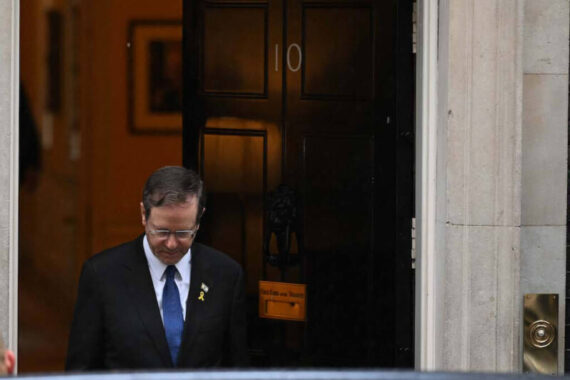
Israeli President Isaac Herzog meets with the British Prime Minister Keir Starmer (not seen) at the Prime Minister's office in Downing Street, London, UK on September 10, 2025. Photo by Anadolu Images.

R

elations between the United Kingdom (UK) and Israel have undergone a notable change over the past two years. Following the war that began in Gaza on October 7, 2023, and turned into a genocide, the British government’s criticism of Israel has grown increasingly forceful. Initially evident mainly in its rhetoric, this shift gradually translated into concrete policy measures.

The UK’s formal recognition of the State of Palestine alongside several other countries in September 2025 marked an important turning point in this regard. The change became more visible in 2026. On June 9, the UK joined Australia, Canada, France, New Zealand, and Norway in imposing sanctions on individuals and entities that financed or facilitated violence against Palestinians in the West Bank. On August 19, it objected to the tender process for the E1 settlement project, which would undermine the West Bank’s geographic contiguity and weaken its connection to East Jerusalem. Finally, on September 8, it joined France and Canada and 11 other countries in banning trade in goods produced in illegal Israeli settlements in the West Bank.

London’s language has also hardened markedly. For example, in a speech to the House of Commons on September 8, 2026, Foreign Secretary Ed Miliband said that “settler terrorists” were carrying out ethnic cleansing against Palestinians in parts of the West Bank. Miliband accused the Israeli government of turning a blind eye to the situation and announced that the UK would henceforth regard Israel’s entire occupation of the West Bank as unlawful. Prime Minister Andy Burnham, writing in The Guardian the same day, emphasized that the measures targeted Israel’s unacceptable policies.

As expected, these British measures drew a sharp response in Israel. Israeli Foreign Minister Gideon Sa’ar described the UK’s latest decisions as interference in Israel’s sovereignty and electoral process. He also announced on September 8 that it had given the UK 30 days to close its consulate in East Jerusalem. In addition, it decided to end British participation in the Gaza coordination mechanism and halt the training that the UK provides to Palestinian forces. It also barred 11 British members of Parliament, including former Labor Party leader Jeremy Corbyn, and one British citizen from entering Israel.

Taken together, these rapid developments inevitably raise a question: Is the UK truly distancing itself from Israel?


Pragmatic distancing rather than a rupture

The latest developments make it easy to answer this question with a simple “yes.” Such an assessment, however, would make it difficult to distinguish what has changed in British policy toward Israel from what has remained the same. On the one hand, London has recognized Palestine, adopted economic measures against illegal settlements, and sharpened its criticism of Benjamin Netanyahu’s government. On the other hand, it is trying to preserve its traditional position on Israel’s security.

Indeed, when announcing the September 8 measures, the UK did not “neglect” to refer to Israel’s legitimate security interests and condemn Hamas’s October 7 attacks. Under these circumstances, it makes more sense to view the current situation as pragmatic distancing rather than a strategic rupture. The UK is avoiding a complete break with Israel while placing greater distance between the two countries as the political cost of supporting the Netanyahu government rises.

The role of Labor governments in this process should not be overlooked. The shift in British policy toward Israel did not occur overnight, but it became increasingly apparent after the Labor Party came to power in July 2024. This new direction, made tangible by the UK’s recognition of the State of Palestine in 2025, advanced further with the measures taken in 2026. Miliband’s use of the term ethnic cleansing in relation to the West Bank and the British government’s decision to regard the entire Israeli occupation as unlawful indicate that the shift will continue in both rhetoric and action. In short, compared with the Conservatives’ more cautious approach, the Labor government is taking a harder line against the Netanyahu government without severing relations with Israel.

It is worth recalling that in 1997, Robin Cook, foreign secretary in Tony Blair’s Labor government, argued that British foreign policy should have an “ethical dimension.” This approach, which sought to connect human rights and democratic values with national interests, was frequently debated in later years because of contradictions in British foreign policy practice. Gaza has revived the same debate under different circumstances. The UK has made international law, human rights, and the two-state solution part of its foreign policy discourse. Against a war at the center of allegations of genocide in Gaza, continuing to give Israel unconditional support became increasingly difficult to reconcile with the UK’s own political position. From this perspective, the Labor government’s harder stance toward Israel recalls the debate over the ethical dimension that Cook introduced years ago.

The rising legitimacy cost of supporting Israel

More than 73,000 Palestinians have been killed in the war that began after October 7, while illegal settlements in the West Bank have expanded and illegal settlers have committed violence against civilians. Together, these developments have increased the political cost to the UK of supporting Israel. After the International Criminal Court issued an arrest warrant for Netanyahu in November 2024 and the Republic of South Africa brought a genocide case against Israel before the International Court of Justice, revising British policy became a necessity rather than a choice. In response to these proceedings, the UK stated that the process prescribed by British law would be followed if Netanyahu entered the country. On the question of genocide, it maintained that the competent court must make the determination while affirming its support for the Court’s independence and the ongoing judicial process.

Moreover, reactions against Israel are no longer confined to particular countries; they have spread around the world. From Türkiye and South Africa to Spain and Canada, political pressure against Israel’s policies in Gaza is growing. What makes this trend especially important for the UK is that Israel’s traditional Western partners are also adopting increasingly critical positions. It is therefore notable that London has not taken its recent measures against Israel alone. By acting together with other countries on sanctions and trade restrictions, the UK exerts pressure on Israel while sharing the political responsibility and potential costs of those decisions. In other words, multilateral action gives London greater room for political maneuver in its dealings with Israel.

Public opinion and economic room for maneuver

Growing opposition across the country to the Israeli government’s policies is also strengthening the domestic political basis for the UK to pursue a more assertive policy toward Israel. Demonstrations against Israel and in support of Palestine across the country, debates in Parliament, and increasingly visible public discontent are putting greater pressure on the government. According to a YouGov survey conducted in September 2026, 52% of Britons supported a ban on imports from illegal Israeli settlements, while only 17% opposed it. Another YouGov survey published in July 2026 showed the extent of the change in public opinion even more clearly. According to that survey, 50% of Britons believed that Israel was committing genocide in Gaza, while 17% disagreed. In short, the domestic political cost of maintaining unconditional support for Israel is steadily rising for the British government.

Economic relations with Israel do not present a serious obstacle to this new political direction. According to data from the UK’s Office for National Statistics, total trade between the two countries amounted to approximately £6 billion in 2025. British exports to Israel accounted for £3.5 billion, while imports from Israel totaled £2.5 billion. The UK therefore runs a trade surplus with Israel. At the same time, Israel’s limited share of the UK’s total foreign trade makes the economic cost of distancing manageable.

Can the UK emerge from Balfour’s shadow?

This is where the issue becomes most ironic. As with Cyprus and Kashmir, the UK is not simply a third party to the question of Palestine. The Balfour Declaration offers the clearest evidence. Issued in 1917 by then British Foreign Secretary Arthur James Balfour, the declaration announced British support for the establishment of a “national home” for the Jewish people in Palestine. Subsequent developments under the British Mandate also played an important role in shaping Palestine’s political and demographic future.

Dr. Hacı Mehmet Boyraz holds a PhD in International Relations. He is a lecturer at Istanbul Medipol University.