From NATO to Shanghai: Why Türkiye Sits at Both Tables
Türkiye now operates across too many geopolitical spaces to be confined to a single one.
September 11, 2026
I
n July, Türkiye was the host in NATO’s family photo in Ankara. Leaders from across the alliance, from the United States and the United Kingdom to Germany and France, gathered at the Presidential Complex. As the summit reaffirmed the allies’ commitment to Article 5 of the Washington Treaty, Ankara also became one of the key venues where NATO’s future security agenda was discussed.
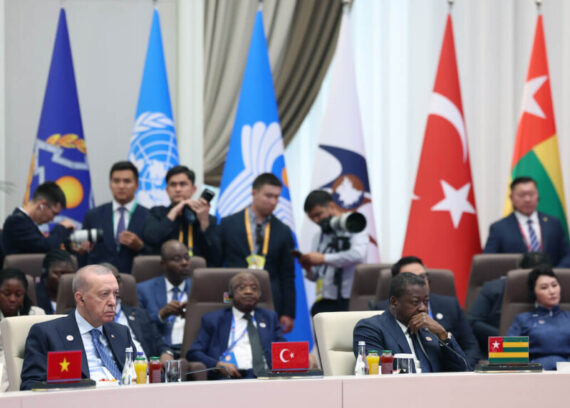
Less than two months later, another family photo was taken, this time in Bishkek. President Recep Tayyip Erdoğan stood alongside Chinese President Xi Jinping, Russian President Vladimir Putin, Indian Prime Minister Narendra Modi, and the leaders of Central Asia at the Shanghai Cooperation Organization summit. Türkiye has been a dialogue partner of the SCO since 2012. On his way back from the summit, Erdoğan said that full membership could also be considered, while stressing that such a step would not mean breaking away from the West or any other institutional framework.
At first glance, the two photographs appear to tell very different stories. Look a little closer, however, and they reveal the same trajectory in Turkish foreign policy.
It is becoming increasingly difficult to measure Türkiye’s diplomatic weight simply by asking which alliance it belongs to. Ankara’s room for maneuver increasingly comes from its ability to engage with different centers of power at the same time. Türkiye remains a NATO ally while deepening its relations with the SCO.
This is therefore about something more than a shift of axis. Türkiye now operates across too many geopolitical spaces to be confined to a single one.
The depth of Türkiye’s relationship with the West is already evident in the numbers.
Trade in goods between Türkiye and the European Union exceeded €217.6 billion in 2025, reaching a new record. Türkiye became the EU’s fifth-largest trading partner worldwide that year. European companies manufacture in Türkiye, Turkish industry is deeply embedded in European supply chains, and the Customs Union has formed the backbone of this economic relationship for almost three decades.
The security picture is even clearer. Türkiye has been a NATO member since 1952. Moreover, the summit held in Ankara once again demonstrated that its position within the alliance cannot be explained by military numbers alone. Many of the regions NATO must simultaneously consider, including the Black Sea, the Eastern Mediterranean, the Balkans, the Caucasus, and the Middle East, lie in Türkiye’s immediate neighborhood.
None of this, however, requires Ankara to limit its relations with the rest of the world.
This is precisely where the Shanghai Cooperation Organization becomes relevant for Türkiye. According to figures cited by Erdoğan in Bishkek, the geography represented by the SCO encompasses roughly 3.5 billion people and an economic volume of about $35 trillion. With China, India, Russia, and the Central Asian states sitting around the same table, it would hardly be economically or geopolitically rational for Türkiye to remain indifferent to such a platform.
For Ankara, the sensible approach is not to choose one space and abandon the other, but to use each relationship according to different national interests. Ankara’s room for maneuver comes precisely from this diversity.
For years, Türkiye was commonly described as a “bridge country.” Today, that description is becoming insufficient. A bridge connects two sides, but it does not determine direction by itself. Turkish foreign policy in recent years has taken on a much more active character.
Türkiye has a role in Black Sea security. It is present in Europe’s energy and trade connections. It also lies at the center of transport routes stretching from the Caucasus into Central Asia. The Development Road project, planned through Iraq and towards the Gulf, could add another route linking Asian trade with Europe through Türkiye.
This is why the emphasis placed in Bishkek on aligning the Middle Corridor with China’s Belt and Road Initiative was hardly accidental.
The Middle Corridor stretches from China through Kazakhstan, across the Caspian Sea, into Azerbaijan and Georgia, before reaching Türkiye and then Europe. The World Bank has also estimated that, with the right investments, the route could substantially increase the volume of cargo transported along it. Türkiye is simultaneously working on projects designed to strengthen railway capacity across the Istanbul Strait and improve the corridor’s connection with Europe.
Türkiye’s geographical location therefore becomes strategically valuable only when it is combined with infrastructure, diplomacy, and economic capacity.
The same logic applies to energy. During Erdoğan’s meeting with Putin in Bishkek, new nuclear projects were discussed alongside the Akkuyu Nuclear Power Plant. Once its four reactors operate at full capacity, Akkuyu is expected to provide around 10 percent of Türkiye’s electricity needs. Ankara is therefore continuing its energy cooperation with Russia while remaining part of the European energy system and pursuing greater diversification of supply.
Trying to place all these relationships on a simple East-West scale makes little sense. Each file has its own calculation.
Perhaps the clearest example of Türkiye’s diplomatic room for maneuver emerged during the Russia-Ukraine war.
As a NATO member, Ankara supported Ukraine’s sovereignty and territorial integrity. Yet it did not close its political channels with Moscow. The result was the Black Sea Grain Initiative, brokered by Türkiye and the United Nations in 2022, which enabled nearly 33 million tones of grain to leave Ukrainian ports for international markets while the war continued.
A similar mechanism is now back on the agenda.
On August 31, Foreign Minister Hakan Fidan said Türkiye had prepared a new plan for the safe passage of grain through the Black Sea and was in contact with both Russia and Ukraine. That development alone says a great deal about Türkiye’s diplomatic position.
Speaking to one side is easy. Having both sides in a war willing to take your call is far more valuable.
Türkiye’s diplomatic relevance does not come from agreeing with everyone. It comes from its ability to maintain dialogue with countries that disagree with one another. Nor is this multidirectional approach limited to the Black Sea.
In August, Türkiye signed the Mecca agreement with Saudi Arabia and Pakistan. The arrangement envisages political and military coordination as well as cooperation in air defense, unmanned systems, electronic warfare, and the defense industry. Ankara therefore remains part of NATO’s collective defense architecture while also helping build additional security networks in its wider neighborhood.
Recommended
The international system today is not as straightforward as it was during the Cold War.
India works with the United States in the Indo-Pacific while sitting alongside China and Russia in the Shanghai Cooperation Organization. Gulf states maintain security relations with Washington while expanding their trade with Beijing. European countries operate alongside the United States within NATO while continuing to conduct hundreds of billions of euros in trade with China.
Türkiye’s policy should also be understood within the realities of this increasingly fragmented international order. Strategic autonomy in this context does not mean abandoning alliances. It means developing additional economic, political, and security options while remaining inside existing ones.
NATO and the SCO are not equivalent organizations in any case. The former is a collective defense alliance. The latter is an Eurasian-based organization that operates across a broader range of issues, from security to trade and transport. Türkiye’s relationship with each is therefore fundamentally different.
Yet the wider picture is still striking. Trying to explain all of this through the old question of “East or West?” is increasingly inadequate. For Türkiye, the real value lies less in choosing one side than in generating options.
As the international system becomes more fragmented, countries capable of sitting at different tables, talking to competing actors, and building connections among them in accordance with their own interests become more valuable.
Perhaps that is precisely what the two-family photos are telling us. Türkiye is no longer best understood as a country caught between East and West. It is increasingly a country with the diplomatic space to engage with both while building a center of gravity of its own.

Göktuğ ÇALIŞKAN is a PhD candidate at the International University of Rabat (UIR) in Morocco, conducting research as a scholar of the Turkish Ministry of National Education (YLSY program). Simultaneously, he serves as an International Relations Specialist at ANKASAM. He holds undergraduate degrees in Political Science and Public Administration (Ankara Yıldırım Beyazıt University) and Law (Erciyes University). He completed his master’s studies at Ankara Hacı Bayram Veli University and UIR (in French). His analyses on global politics and security have been featured in various international outlets, including Türkiye Today, Daily Sabah, TRT Afrika, and FokusPlus.
You can see how this popup was set up in our step-by-step guide: https://wppopupmaker.com/guides/auto-opening-announcement-popups/

Stay informed by subscribing to
our weekly newsletter.
You can see how this popup was set up in our step-by-step guide: https://wppopupmaker.com/guides/auto-opening-announcement-popups/
You can see how this popup was set up in our step-by-step guide: https://wppopupmaker.com/guides/auto-opening-announcement-popups/
You can see how this popup was set up in our step-by-step guide: https://wppopupmaker.com/guides/auto-opening-announcement-popups/
You can see how this popup was set up in our step-by-step guide: https://wppopupmaker.com/guides/auto-opening-announcement-popups/