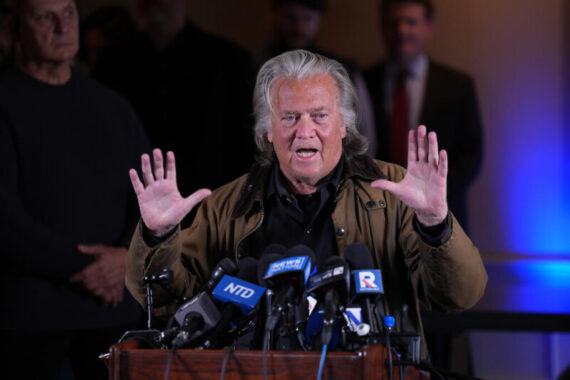
The Bannon Effect and Trumpism in European Politics
One of the theses Bannon has advocated in the past is that Christian thought is dead in Europe and Islam is on the rise.
March 16, 2026
I
n Germany, in September 2013, a new party narrowly missed entering the federal parliament (Bundestag) in its first election, receiving only 4.7% of the vote. The Alternative for Germany Party, or AfD for short, founded in April 2013, quickly completed the necessary registration requirements at the federal level and qualified to participate in the parliamentary elections. At the time, it was not surprising that the AfD, considered by many to be a populist, anti-European party fueled by conspiracy theories and making empty promises and threats in its political rhetoric, failed to enter parliament. Indeed, experts had stated that German voters would never show interest in such political movements.
The most unpredictable turning point in the political history of Germany, which was rebuilt after World War II, was the dismissal of the AfD after the 2013 federal parliamentary elections, and its being seen as a politically insignificant movement. This policy of ignoring the AfD shaped the political attitude towards it. It paved the way for the unstoppable rise of the AfD in Germany, which began with the 2014 European Parliament elections. At the same time, it created rifts in the German social structure, opening the way for far-right and populist movements like PEGIDA and helping the AfD to build voter support.
Far-right movements in Europe, long ignored as in Germany, began to emerge as a rooted political movement from 2010 onwards. In January 2017, the “ENF (Europa der Nationen und der Freiheit)” political group in the European Parliament met in Koblenz, Germany. This meeting witnessed some very interesting encounters and statements. Nearly 40 far-right representatives from 9 countries that had far-right parties represented in the European Parliament at the time attended this meeting.
Led by Marie Le Pen of the French Front National, the meeting also featured speakers including Geert Wilders from the Netherlands, Frauke Petry from the AfD leadership in Germany, and Matteo Salvini representing the Lega Nord in Italy. The outcome of the meeting was quite alarming: Nine far-right European parties, led by Le Pen, who describe the European Union as an oppressive regime for the European people, pledged a new European future, declaring that the current EU and world system has ended and that the construction of a new future has begun.
Another significant event at the Koblenz meeting was the celebration of Trump’s election as U.S. President in 2017 by representatives of European far-right movements, who called for a new wave of freedom in Europe, a “European Nationalism.” Even today, many consider the Koblenz meeting, although Steve Bannon did not directly attend, to be one of the first movements in Europe within the context of his “Global Populism” network, and the first example of the European far-right movement becoming jointly visible on the international stage.
Bannon’s success in Trump’s election, his subsequent impeachment, and his then-return to Europe present a rather interesting chain of events. His active involvement in European politics through “The Movement,” a Brussels-based foundation he established in 2017, his overt efforts to create a far-right, anti-EU supergroup within the European Parliament, and the similarities between these actions and the call made by far-right political parties at a meeting in Koblenz in 2017 are all highly noteworthy.
Following the Koblenz meeting, an examination of undeniable connections reveals that Steve Bannon met with numerous far-right populist politicians and political party officials in 2018-2019. One of Bannon’s biggest admirers is the leader of the Dutch PVV party, Geert Wilders. Many other far-right or right-wing populist politicians, including Alice Weidel of the AfD, Matteo Salvini of the Lega, UKIP leader Nigel Farage, Marine Le Pen of France, and Giorgia Meloni of Italy, also frequently met with Bannon.
Hungarian Prime Minister Viktor Orban and Czech President Zeman are also among those who have met with Bannon in the past. His participation in Le Pen’s party general assembly in France in 2018, and his invitation to a conference in the Bundestag by the AfD, are examples of the unhidden connections within the Populist/Global Network that Bannon is trying to build.
Prior to the EU Parliament elections in May 2019, Bannon made various efforts to unite the European far right. Although his target of one-third of the vote was not achieved in the 2019 European Parliament elections, Bannon provided the European far right with an unprecedented opportunity, creating a political network of far-right and populist groups across Europe and even across the Atlantic.
Just as there was a tendency to ignore the rise of the far right, a large media outlet, looking at the results of the 2019 EU Parliament elections, lamented Bannon’s failure. However, what seemed like a failure to those trying to save the day, or even the moment, for European politics, actually brought together the European far right and populist political base. Bannon’s intervention gave further impetus to the European far right and populist movements. In Germany, the AfD became the main opposition party in the federal parliament after the 2017 Federal Parliament elections. In the 2025 elections, it increased its number of members in parliament to 152 as the main opposition party.
In 2023, Wilders’ party PVV emerged as the leading party in the Dutch elections. In last year’s Czech elections, the right-wing populist party ANO, with Andre Babis, won as the leading party. Marine Le Pen reached the second round twice against Macron in the French presidential elections and lost, but increased her vote share each time. The party, formerly known as Front National, changed its name to Rassemblement National (RN) and won the local elections as the leading party. It is highly likely to be the leading party again in the elections to be held in March 2026. Furthermore, Le Pen is considered a sure winner of the 2027 presidential elections – providing she remains eligible to run.
The situation is no different across Europe. Far-right radical parties and right-wing populist parties, which have a significant presence in national elections, entered the EU Parliament in the 2024 elections with 187 members in three different groups. In the EU Parliament, far-right and right-wing radical parties formed a group under the name European Patriots (Patriots.eu), while anti-EU right-wing parties such as the European Conservatives and Innovators (ECR) and far-right radical parties like the AfD formed a group under the name ESN (Europe of Sovereign Nations). These far-right parties, constantly appearing to be seeking innovation and new directions across the EU, have increased their number of members in the parliament through name changes. The common characteristic of these groups is their anti-EU skeptical nature.
News that the Trump administration would focus on Italy, Austria, Poland, and Hungary leaving the EU, as outlined in the National Security Document (NSS) released in the U.S. in December 2025, sent shockwaves across Europe. While the White House denied these statements were included in the NSS, the fact that Bannon could, even years later, achieve his goal of creating an anti-European movement seems quite plausible after witnessing the examples of UKIP and Brexit.
Examinations of the released Epstein files indicate that Epstein and Bannon corresponded regularly between 2018 and 2019 regarding European politicians and the European far right and populist right-wing movements. In these communications, Bannon reportedly shared information about his influence on right-wing movements in Europe, specifying which politicians and parties he advised, and even naming the parties and politicians involved. While the AfD has not denied the portion of the conversations related to them, they have stated that the allegations of receiving advice from Bannon are untrue.
From the perspective of far-right and populist right-wing movements, it is possible to state that far-right political movements in Europe share three distinct common narratives. These narratives are: opposition to the European Union or the withdrawal of their countries from the European Union; xenophobia and hostility towards immigrants and foreigners, aiming to eliminate immigration to Europe; and the exclusion of Islam from the public sphere in Europe, imposing bans on Islam at the national level and restricting the rights of Muslims. According to AfD ideologue Björn Höcke, Muslims, considered foreign elements in Europe, should be expelled east of the Bosphorus. Bannon’s statements also periodically emphasize the need for a “very strict and aggressive stance against radical Islam.”
Another point worth emphasizing is the emboldening of far-right and populist movements in Europe following Trump’s re-election for a second term. It is noteworthy that these movements have brought Trump’s MAGA (Make America Great Again) or America First slogans to Europe. Babis’s campaign in the Czech Republic with the slogan “Czech Republic First,” and Hungarian Prime Minister Orban’s implementation of the MEGA (“Make Europe Great Again”) slogan during Hungary’s rotating presidency, demonstrate the spread of a different kind of Trumpism across Europe.
The stance of the Visegrad countries, members of the EU, on anti-immigrant sentiment has long been well-known. In other Western European countries, anti-immigrant sentiment and the halting of immigration are at the forefront of the main election slogans of political parties. Trump’s claims that Europe will lose its identity due to immigration by the end of 2025, and that the continent is destroying itself due to an immigrant invasion, have strengthened the rhetoric of right-wing populist and far-right parties in Europe. Even at the local level, in the German state of Bavaria, the AfD party has included in its party program the possibility of establishing a special team called AFA (Refugee Search and Deportation Police), similar to ICE in the U.S., if they come to power in that state.
Recommended
One of the theses Bannon has advocated in the past is that Christian thought is dead in Europe and Islam is on the rise. Bannon is known to have repeatedly stated that “the EU needs to take action against radical Islam ‘very quickly’.” Although openly defined as Islamophobia or racism in public discourse, anti-Islamism, an indispensable discourse for far-right and right-wing populist political movements in Europe, has reached a new dimension. Particularly the idea of a “Nationalist International” across Europe, agreed upon in Koblenz in 2017 to protect Europe’s cultural identity, the concept of cleansing Europe of Muslim immigrants to ensure cultural harmony and unity necessitates treating radical Islam as a security threat.
This idea is explicitly stated in the party programs of far right and right-wing populist movements in Europe, asserting that Islam does not belong to their countries or to Europe. European Patriots have begun to fight against the Islamization of Europe. Far-right movements exploit every opportunity to organize themselves within this framework.
The current situation is that, rather than developing a method to combat far-right and right-wing populist movements, centrist movements, fearing voter loss, have begun to adopt far-right rhetoric and policies. Despite the fact that the far-right and right-wing populist movements pose a significant threat to European unity, the reluctance of established centrist political movements to take countermeasures, change their rhetoric and actions, or address structural problems that would undermine the rhetoric of far-right movements is both concerning and alarming.
Europe is facing a layered far right and racist political movement that is becoming increasingly deeply rooted and expanding its networks.
(Originally published in Turkish by Kriter)

Dr. Muhterem DİLBİRLİĞİ is a Turkish academic who serves as the Education Attaché, Turkish Consulate General in Cologne.
You can see how this popup was set up in our step-by-step guide: https://wppopupmaker.com/guides/auto-opening-announcement-popups/

Stay informed by subscribing to
our weekly newsletter.
You can see how this popup was set up in our step-by-step guide: https://wppopupmaker.com/guides/auto-opening-announcement-popups/
You can see how this popup was set up in our step-by-step guide: https://wppopupmaker.com/guides/auto-opening-announcement-popups/
You can see how this popup was set up in our step-by-step guide: https://wppopupmaker.com/guides/auto-opening-announcement-popups/
You can see how this popup was set up in our step-by-step guide: https://wppopupmaker.com/guides/auto-opening-announcement-popups/