A
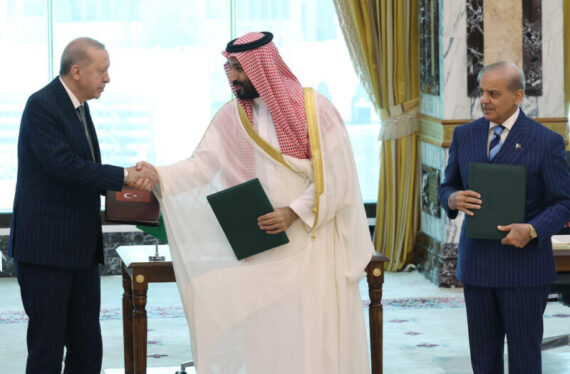
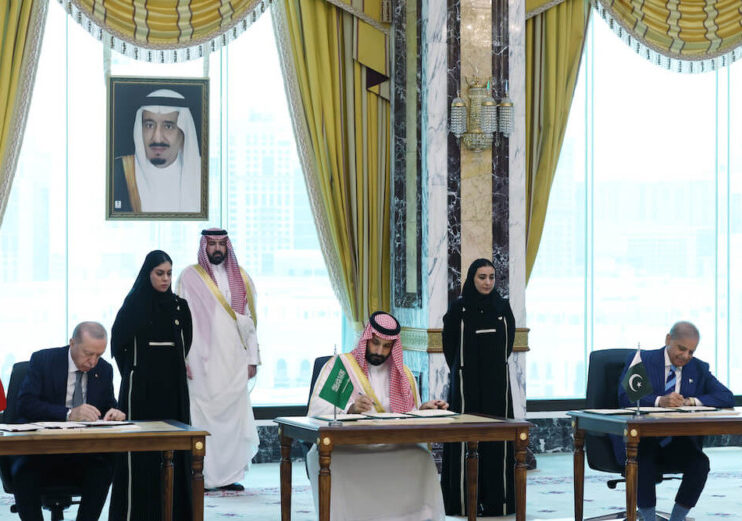
ugust 7, 2026, marks a historic turning point at which the cards of Afro-Eurasian geopolitics and the global security architecture were reshuffled. President Recep Tayyip Erdoğan’s working visit to Saudi Arabia brought together Saudi Crown Prince Mohammed bin Salman, Pakistani Prime Minister Shahbaz Sharif, who had arrived in Saudi Arabia the day before the visit, and General Asim Munir at the same table. The defense-focused trilateral ‘Mecca Agreement’, were signed following months of diplomatic maneuvering, and were announced at a time of rising military tensions in the region and US-Iran conflict threatening Gulf security.
Analyzing this critical development from the perspective of Islamabad is of vital importance for understanding Pakistan’s defense network, which stretches from Africa to the Gulf; its chronic and hybrid challenges in internal security; and its foundational role at the crossroads of Afro-Eurasia.
From nuclear power to regional security architecture: Pakistan’s role
As the only nuclear-armed state in the Muslim world, Pakistan constitutes the most deterrent and high-calibre military human capital component of this alliance. The bilateral defense pact signed with Saudi Arabia in 2025 was a consequence of Riyadh’s quest for military assurances, including nuclear deterrence, against potential security threats. However, Turkey’s inclusion in this equation as an official and institutional partner elevates Pakistan’s role as a bilateral ‘security provider’ to a much broader and more balanced framework.
From the perspective of the Islamabad administration, this agreement is not merely a single Gulf commitment, but the culmination of a multi-layered strategy stretching from the Horn of Africa to the Persian Gulf. Indeed, the Memorandum of Understanding on Defense Cooperation signed last week between Pakistan and Somalia, a year after it was approved by the Somali Cabinet, demonstrated Islamabad’s determination to play an active role in ensuring the security of navigation in the Red Sea and the Indian Ocean.
Furthermore, the Kuwaiti Parliament’s approval in late July of the long-awaited defense cooperation agreement with Pakistan, alongside the pursuit by actors such as Bahrain and Jordan of reciprocal defense agreements modelled on the Saudi model, has cemented Islamabad’s position as the region’s ‘security architect’. Consequently, the Turkey–Saudi Arabia–Pakistan triad forms the backbone not only of these three countries but also of a broader Afro-Eurasian security network.

Synergy of capital, technology and military manpower
Viewed from the perspective of Islamabad, the tripartite alliance is more than just a military pact; it is an industrial lever that brings together finance and high technology. For many years, Pakistan’s military diplomacy has provided Saudi Arabia with training, military personnel and security support, whilst in return it has relied on Gulf funding. However, when the high technology, unmanned systems and operational capabilities of the Turkish defense industry are added to this equation, Pakistan finds an opportunity to move beyond being a passive exporter of security and position itself at the center of a tripartite industrial synergy.
When Saudi Arabia’s financial strength, Turkey’s advanced defense technology and Pakistan’s regional military expertise and growing production infrastructure are combined, a domestic and independent defense bloc and an integrated ecosystem emerge at the very intersection of Afro-Eurasia. At a time when Pakistan is grappling with financial difficulties, this agreement enables it to secure direct Saudi investment whilst also modernizing its domestic defense industry through joint defense projects with Turkey, thereby opening up new market opportunities for both Turkish and Pakistani defense companies.
Internal security challenges and allegations of sabotage
Pakistan’s ambitious foreign policy on the global stage is being tested by chronic internal security challenges and regional hybrid threats. The Islamabad administration has long been grappling with violence perpetrated by the Pakistani Taliban (TTP) in the province of Khyber Pakhtunkhwa, whilst in the south-west it has been combating separatist actions by the Baloch Liberation Army (BLA) targeting economic infrastructure and Chinese projects.
However, the recent escalation of social tensions and protests in Pakistan-administered Kashmir (Azad Kashmir) has added a new dimension to the security equation. Strategic circles in Islamabad argue that the unrest erupting in Kashmir is not merely the result of local administrative or economic grievances; rather, they contend that it has been exacerbated by the instigations of external actors who are displeased with Pakistan’s key role in its independent balancing diplomacy with Iran and within the now-concrete Turkey-Saudi Arabia-Pakistan Tripartite Alliance, which is now taking concrete form. This situation illustrates that, whilst Islamabad is fighting the actions of the TTP and the BLA on the one hand, it is also forced to contend with the hybrid front opened up via Kashmir by forces seeking to undermine the regional influence of the Tripartite Alliance.
A delicate balance in foreign policy: The Iran-China Axis
As Pakistan takes a leading role in this new alliance, another major challenge it faces is managing the process without damaging its relations with its neighbor Iran or its strategic partnership with China. Islamabad has recently been engaged in active shuttle diplomacy to prevent US-Iran tensions from spilling over into the Gulf, adopting a balanced stance by taking on a mediating role. Turkey’s similarly rational approach, which keeps diplomatic channels open, makes it easier for Pakistan to present this alliance as a ‘shield for regional stability and deterrence’ rather than an ‘anti-Iran bloc’.
Furthermore, Pakistan, which maintains unshakeable ties with Beijing through the China-Pakistan Economic Corridor (CPEC), is enhancing its manoeuvrability within the arena of global power competition thanks to this security umbrella, which it has expanded to include Turkey, Somalia, Kuwait and Saudi Arabia. Islamabad is positioning itself not merely as an extension of either the Eastern or Western bloc, but as a key guardian of Afro-Eurasian trade and security routes.
Recommended
A new geopolitical Turning Point for Islamabad
Consequently, the Turkey-Pakistan–Saudi Arabia Trilateral Summit of August 7, 2026, and the joint defense agreement represent a multi-layered strategy of gains for Pakistan. Whilst Islamabad is strengthening its regional deterrence in both the nuclear and conventional spheres, it is also aiming to deepen its strategic partnership with Turkey and transform its historical ties with Saudi Arabia into an institutionalized security pact. The Turkey-Saudi Arabia-Pakistan trilateral partnership, building upon defense agreements stretching from Kuwait to Somalia, is establishing a new center of power at the crossroads of Asia, East Africa and the Middle East.
The key challenge facing Pakistan is to successfully shoulder this heavy international responsibility whilst managing internal security challenges, such as those posed by the TTP, the BLA and the Kashmir front, and addressing social sensitivities. However, the current picture clearly shows that Pakistan no longer wishes to be confined to the role of a country trapped in regional rivalries in South Asia; it seeks to update its status as one of the key actors in the Afro-Eurasian region, stretching from the Horn of Africa to the Gulf, where it plays a pivotal role in peace, deterrence and balance.
(Originally published in Turkish by Kriter)