Unable to Move Beyond Netanyahu: Interregnum in Israeli Politics
Reading the election results in Israel solely in terms of whether Netanyahu won or lost would be insufficient.
November 6, 2026
T
he October 27 elections in Israel have moved the debate over Netanyahu’s political future into a new phase rather than bringing it to a conclusion. The results have made it more difficult for the prime minister to secure another majority with his existing partners, but they have not automatically provided the parties opposing him with a viable governing coalition. The gap between the erosion of Netanyahu’s support and the formation of a post-Netanyahu government is the central issue in the aftermath of the election.
In this sense, Israeli politics is facing an interregnum: an interim period in which the incumbent government remains in office, but the political consensus needed to replace it has yet to emerge. How long this period lasts will depend not only on the distribution of seats, but also on which alliances the parties consider legitimate and politically feasible.
As of October 29, with vote counting still underway, the bloc led by Netanyahu holds 53 seats, the opposition parties gathered around Gadi Eisenkot have 48, and the Arab parties hold a combined 19 seats. Although the distribution is not yet final, it shows that Netanyahu has failed to secure a majority in the 120-member Knesset with his existing partners. At the same time, it indicates that the parties led by Eisenkot cannot form a majority without developing some form of cooperation with the Arab parties.
In a country such as Israel, where governments are formed through coalitions, it is not unusual for no single party to win an outright majority. The problem here is the difficulty of turning the numerical combinations capable of forming a government into politically acceptable partnerships. When the seats held by parties opposed to Netanyahu are added together, they produce a potential majority, but that majority does not yet have a common government program, an agreement on leadership, or mutual trust. Wanting Netanyahu to leave office and agreeing on how the country should be governed after his departure are two different matters.
For this reason, reading the election results solely in terms of whether Netanyahu won or lost would be insufficient. It is clear that the prime minister’s inability to secure a majority with his own bloc has narrowed his room for maneuver. However, the opposition’s difficulties in forming a coalition could prevent this setback from translating into a change of government. It is also worth remembering that Netanyahu’s ability to remain in office until a new government is formed gives him an advantage in terms of continuity that extends beyond the support he secured in the election.
At the heart of the deadlock, despite the majority of votes going to parties opposed to Netanyahu, is the tension between the parliamentary weight of the Arab parties and the roles they are permitted to play in government formation. Arab voters can alter the distribution of parliamentary representation, but the conditions under which their representatives can participate in forming a government remain contested. The central problem is that the Arab parties, which collectively constitute the third-largest bloc in terms of votes received, have become normalized as a reserve force expected to provide external support to a coalition rather than as political actors capable of helping form the government themselves.
Israel’s ethnocratic regime, founded on the supremacy of Jews in every sphere, is the fundamental structural reason behind claims that the opposition cannot secure a majority. In fact, a sufficient number of voters turned out to express their will and bring about Netanyahu’s political removal. That will has been reflected in the Knesset through 67 seats held by the Zionist opposition, the Joint List, and Ra’am combined. This very electoral picture and the debate surrounding it once again expose the reality that Palestinian citizens of Israel are not treated as equal citizens. Under these circumstances, post-election negotiations confront a question even before the distribution of ministerial portfolios: who is considered a legitimate partner in government?
The concept of interregnum captures precisely this uncertainty. There is no vacuum in which state authority has disappeared; the incumbent government remains in office. What is suspended is the political agreement needed to produce a new government from the election results. The transition beyond Netanyahu therefore depends less on the number of seats held by his opponents than on their ability to bring those seats together under a shared governing mandate.
Netanyahu’s ability to remain at the center of the struggle for power despite losing ground in the election cannot be explained solely by his personal political skills. His resilience is rooted in competing assessments of the war’s consequences and the political struggle over responsibility for October 7. In response to the opposition’s criticism over security failures, the continuing war, and accountability, Netanyahu has developed a narrative of success centered on weakening Israel’s enemies and expanding the country’s regional power.
Within this narrative, the war is judged less by whether the fighting has ended than by the damage inflicted on Israel’s adversaries and the expansion of Israel’s military freedom of action. Policies that could be characterized as expansionist are therefore presented in Netanyahu’s framework as measures to push threats farther from Israel’s borders and restore deterrence. From this perspective, the expansion of military control can be understood not only as a consequence of the burden of perpetual war, but also as a means of providing security. What matters here is not that the costs are overlooked, but rather the gains for which those costs are considered acceptable. Nevertheless, it is worth emphasizing that the election results alone are insufficient to measure the weight of this narrative in shaping voter behavior.
The second pillar of Netanyahu’s narrative is the separation of responsibility for the security failures from ownership of the military gains that followed. The Likud campaign attributed the success of operations against Hamas, Hezbollah, and Iran to the prime minister’s leadership, while shifting responsibility for the warnings and preparations that were lacking before October 7 onto the security establishment. This approach has allowed Netanyahu to present himself as the leader of the military response that followed the disaster without accepting political responsibility for the catastrophe that occurred during his tenure.
The deeper political function of this rhetoric is that it can erode public confidence in institutions empowered to demand accountability. When the security establishment is portrayed as an institution that failed to inform or was obstructing the prime minister, the debate over the leader’s failures shifts toward the credibility of the institutions themselves. Within such a framework, support for Netanyahu can become not only an endorsement of his past performance, but also an expression of opposition to institutions and elites perceived to be aligned against him.
This makes it clearer that the erosion of Netanyahu’s support and the end of his political influence cannot be treated as the same process. Bonds built around security, identity, and distrust of institutions can make it difficult for criticism of the government’s record to translate directly into demands for a change of leadership. The picture emerging from the Israeli election results supports this argument. At this point, the opposition’s task is not merely to demonstrate Netanyahu’s responsibility, but also to offer a credible alternative to the security and governance claims he represents.
The central dilemma facing the parties positioned against Netanyahu is how to turn their shared opposition into a common governing mandate. The political camps represented by Eisenkot, Bennett, Liberman, and Golan may agree on the need to replace the prime minister, but they do not share the same vision of the scope of that change. For some, the priority may be a change in leadership and governing style. For others, replacing the government must also involve repairing institutions and restructuring relations between the state and society.
What kind of political order should follow Netanyahu is therefore a question the opposition must answer among its own ranks. These differences become more pronounced when campaign promises are expected to become binding commitments in coalition negotiations. Rejections of cooperation with the Arab parties, in particular, conflict with the goal of replacing Netanyahu. Liberman’s position, which rules out partnerships with Netanyahu, the Haredi parties, and the Arab parties alike, is one of the clearest examples of this tension. The boundaries established during the campaign to define political identities are now narrowing the options for forming a government.
The threshold the opposition must cross is therefore not simply an agreement on a candidate for prime minister. It must determine which decisions can be made collectively on issues such as Haredi military conscription, the role of the judiciary, and the security policy to be pursued after the war. Uniting around criticism of Netanyahu will not eliminate disagreements on these matters. If a governing coalition is to be formed, the opposition should have clarified before the election which areas it intends to transform, where it is prepared to seek compromise, and which disagreements it would be willing to postpone.
Moreover, while appealing to voters seeking change, the opposition also aimed to attract right-wing voters who might be willing to abandon Netanyahu’s camp. Its reluctance to cooperate with the Arab parties, emphasis on a hard-line security policy, and efforts to distance itself from Netanyahu can be understood in light of this dual objective. However, it was also clear that the rhetoric used to win support at the ballot box could limit the flexibility needed to form a government. The picture that emerged after the votes were counted, perhaps unexpectedly, has created a situation in which some opposition figures may have to backtrack on their campaign statements.
This is where an asymmetry emerges in Netanyahu’s favor. For the opposition to take power, it must build a coalition capable of managing its differences. Netanyahu, by contrast, may remain in office for some time simply because that coalition cannot be formed. Israel’s transition beyond Netanyahu is stuck precisely at this point. The demand for a change of leadership must become an agreement in which the parties are willing to bear the political costs of governing together.
The Arab parties’ increased strength in the 2026 elections, with 19 seats in the Knesset, has taken the post-election debate beyond the arithmetic of government formation. The central issue is how much influence the representation won through the votes of Palestinian citizens can have in shaping the executive branch. The preemptive rejection of cooperation with parties capable of helping establish a parliamentary majority makes government options that are numerically possible politically inaccessible.
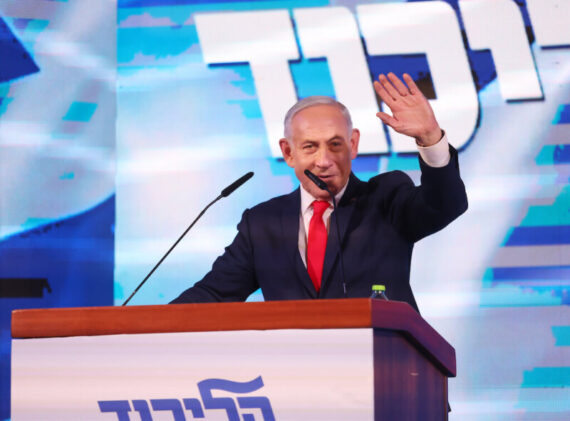
In this regard, Netanyahu’s emphasis in his election-night speech on the right’s majority among the Jewish public, rather than the distribution of seats in the Knesset, is significant. Meanwhile, his call for a united Jewish and Zionist majority offers a framework that calls into question the legitimacy of a government that might depend on support from the Arab parties. Thus, the question of what kind of government the election results will produce is joined by another: whose representatives can be considered decisive participants in forming that government?
This exclusion reflects the way Israel’s ethnocratic structure is reproduced in electoral politics. Palestinian citizens can vote and send representatives to parliament, but their right to participate as equal and legitimate partners in governing the state is continually questioned. While their citizenship is recognized in law, the political consequences of that status are restricted on the basis of ethnic identity. The result, ultimately, is an emptied-out form of citizenship. The vote of a Palestinian citizen is accepted as long as it determines the distribution of seats; when, as in this election, it carries enough weight to influence who forms the government, it is presented as a problem of legitimacy.
It is therefore important to recognize that the inequality at issue is not simply the complete absence of representation, but the obstruction of the transformation of representation already secured into political power. Netanyahu’s emphasis on a “Jewish majority” makes this hierarchy explicit. The votes of all citizens are counted, but their right to decide who governs the country is not treated as equal.
This approach also places the opposition before a difficult choice. Rejecting cooperation with the Arab parties could make it easier for Netanyahu to remain in office. Moving toward cooperation, on the other hand, could require the opposition to reconsider its campaign promises and explain that decision to voters. This is precisely where opposition to Netanyahu will be put to the test. Will the opposition be willing to challenge existing boundaries over who can legitimately participate in political competition as it seeks to build the coalition necessary for a change of government?
At the same time, it would be misleading to treat the Arab parties as a ready-made bloc of seats that the opposition can turn to whenever it needs them. These parties are political actors with responsibilities to their own voters and differences among themselves. Joining a government, providing external support, and cooperating on specific parliamentary votes entail different commitments. How any potential agreement would address the demands of Arab citizens concerning security, equality, resource allocation, and political representation would also be part of the negotiations.
The fact that the Arab parties want Netanyahu to leave office does not mean they would unconditionally support every alternative government that might be formed. Their position therefore makes both the arithmetic and the political nature of Israel’s deadlock visible. As long as the gap between representation won at the ballot box and acceptance as a governing partner remains unbridged, the ability of the majority opposed to Netanyahu to form a government will remain limited. If “post-Netanyahu” is a genuine objective, the Jewish opposition must also be prepared to confront the political implications of equal citizenship.
A prolonged government-formation process will not have the same consequences for all political actors. For the opposition, the passage of time could erode the possibility of change reflected in the election results. For Netanyahu, it could mean remaining in office for longer. His ability to continue serving as prime minister until a new government is formed will allow him to remain at the center of power without having regained a majority. In this sense, Netanyahu will be a living example of the fact that losing ground in an election does not necessarily mean losing office.
His advantage during this process stems from the simultaneous need for compromise facing the opposition. To form an alternative government, different parties must reach agreement on leadership, policy, and the conditions for support. Netanyahu, meanwhile, can benefit from their failure to reach such an agreement. A single unresolved critical disagreement may be enough to prevent a formula capable of bringing all the opposition’s components together in one government. As a result, the political cost of blocking a change of government may become lower than the cost of establishing a new governing coalition.
Remaining in office will also allow Netanyahu to participate in government-formation negotiations in his capacity as the incumbent prime minister. This position matters in terms of setting the security agenda, addressing the public, and representing continuity in state administration. Netanyahu is therefore likely to present himself not as the source of uncertainty, but as a leader capable of providing stability in the face of it. The opposition’s difficulties in reaching an agreement could become material for this argument. The claim that parties unable to form a government together cannot govern the country together may become one of the tools used to turn the transition period to the advantage of the incumbent leadership. It is evident that Netanyahu will not hesitate to exploit this opportunity.
Nevertheless, remaining in office will not give Netanyahu unlimited room for maneuver or a new democratic mandate. The distribution of seats in the new parliament gives the parties opposing him opportunities to exercise oversight and take political initiatives, provided they can cooperate. His advantage in time therefore depends on the opposition’s fragmentation; it is not an unchangeable advantage.
The fundamental contradiction of the interregnum becomes clear here. While the leader at the head of the interim government remains in office, those seeking to replace him must prove that they can act together. The election may have weakened Netanyahu’s claim to a majority, but turning that result into an actual change of government depends on whether the opposition can demonstrate the political will to ensure that time works in its favor.
Recommended
There are three main ways Israel could emerge from the interim period it has entered.
The first is for the parties led by Eisenkot to reach an agreement with the Arab parties, either on joining the government or providing external support. This option could turn opposition to Netanyahu into a governing coalition. However, it would require the opposition to move beyond the boundaries it has set for itself, accept the demands of the Arab parties as legitimate elements of the negotiations, and defend the resulting compromise to its voters. The durability of such a government would depend not merely on the objective of removing Netanyahu from office, but on an agreed governing program.
The second option is a government formula that crosses the boundaries of the existing blocs. This could emerge if Netanyahu wins partners from the opposition or if a different leadership arrangement involving Likud becomes possible. However, a broad-based government would not automatically amount to political renewal. Unless questions concerning who would lead the government, how responsibility for October 7 would be investigated, and how disputes over the judiciary and military conscription would be addressed are resolved, such a coalition could bring the crisis into the government rather than resolve it. In particular, an arrangement that allows Netanyahu to remain prime minister could effectively compensate for the erosion of his electoral majority by bringing in new partners.
The third option is the failure to form a government and the holding of another election. However, if the same political vetoes remain in place, a new vote may not produce a different governing option. Asking voters to make another decision would not absolve the parties of their responsibility to reach an agreement based on the existing results. Meanwhile, Netanyahu would continue to remain in office throughout the process.
Ultimately, it would be incomplete to interpret the election results solely as Netanyahu’s defeat or as another instance of his political survival. His loss of strength is real, but the numerical weight of the parties opposing him has not yet translated into a coalition capable of taking power. What is preventing the transition is not only Netanyahu’s resistance, but also his opponents’ inability to agree on the conditions for governing together.
Moreover, for Israel to move beyond Netanyahu, it must decide not simply who will replace him, but with whom and according to which principles the country will be governed. As long as the representation of Palestinian citizens is treated as illegitimate in calculations over government formation, the majorities produced by the ballot box will not be able to generate an alternative government. Netanyahu’s future and the ethnocratic boundaries of Israeli politics are intertwined at this point. Whether the interregnum comes to an end will depend on whether those opposing Netanyahu are prepared to challenge and change these boundaries.
(Originally published in Turkish by Kriter)

Tuğçe Ersoy-Ceylan graduated from Galatasaray University and continued her studies at the Center for Middle Eastern and Mediterranean Studies at Université Lyon II in France. She received her M.A. degree from the Middle East Studies program at Middle East Technical University (METU) and her Ph.D. from the Middle East Research Institute at Marmara University. In 2015, she conducted field research at the University of Haifa in Israel. In 2022, she was a visiting scholar at the Schusterman Center for Israel Studies at Brandeis University.
Tuğçe Ersoy-Ceylan works as an associate professor in the Department of International Relations at İzmir Kâtip Çelebi University. Her book Conflicting Identities in Israel: Palestinians and Jews was published in 2020. Her edited volume Israel: Identity, Politics, Foreign Policy, Security—the first comprehensive reference book on Israel Studies in Turkish—was published in 2022 and released its second edition in 2025.
You can see how this popup was set up in our step-by-step guide: https://wppopupmaker.com/guides/auto-opening-announcement-popups/

Stay informed by subscribing to
our weekly newsletter.
You can see how this popup was set up in our step-by-step guide: https://wppopupmaker.com/guides/auto-opening-announcement-popups/
You can see how this popup was set up in our step-by-step guide: https://wppopupmaker.com/guides/auto-opening-announcement-popups/
You can see how this popup was set up in our step-by-step guide: https://wppopupmaker.com/guides/auto-opening-announcement-popups/
You can see how this popup was set up in our step-by-step guide: https://wppopupmaker.com/guides/auto-opening-announcement-popups/