Planetary Sovereignty Begins Within: Lessons from Australia and Tibet
Indigenous governance, led equally by women and men, has long operated through balance, consensus, and reciprocity.
October 29, 2025
W
hat if the solutions to humanity’s greatest challenges — from the climate crisis to cycles of violence and displacement — begin with something profoundly personal: the awakening of each individual’s inner sovereignty?
Across cultures, peoples who have faced genocide or dispossession continue to demonstrate ways of thriving that arise from deep spiritual grounding. Their resilience points toward a form of governance not built solely on power, but on relationship — with land, each other, and the wider universe.
Since the beginning of human history, societies have asked: How do we organize ourselves so that everyone can flourish? Who gets to make decisions, and how do we define our place within the vast cosmos?
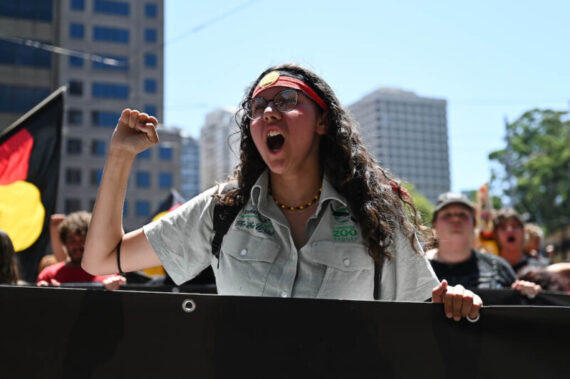
In Australia, these questions echo through the Uluru Statement from the Heart, which calls for Voice, Treaty, and Truth — an enduring expression of Indigenous leadership in shaping the nation’s moral future. The statement’s strength comes not from political systems alone, but from a worldview that understands law as lore — the sacred pattern connecting people, ancestors, land, and stars.
Growing up in Cloncurry on Kalkadunga country in the 1970s, I heard many Indigenous languages spoken and saw two very different worlds side by side. The colonizing white presence was visible everywhere, yet it could not overpower the quiet, unbroken sovereignty of Country itself. Across more than 500 languages, ancestral wisdom continues to live in the waters, skies, and landscapes of the continent.
Indigenous governance, led equally by women and men, has long operated through balance, consensus, and reciprocity — systems that stand in contrast to patriarchal, capitalist models that separate power from care. The continuing call for Indigenous self-governance in Australia reveals how colonial structures still struggle to understand this deeper order.
The defeat of the 2023 Indigenous Voice referendum in Australia, driven by fear and misinformation, was a blow to many. Yet it also catalyzed a quiet transformation. Across the country, individuals began confronting their personal complicity in the colonization of stolen lands. Speaking these truths aloud — in families, communities, and local gatherings — has become its own form of healing.
This movement, emerging from within rather than imposed from above, reflects a shift from external authority toward inner responsibility. It is an expression of the same principle that sustains Indigenous cultures: sovereignty begins within and radiates outward into collective life.
A similar story unfolds in Tibet, where cultural genocide under Chinese occupation continues. Ancient monasteries and homes have been destroyed, and Tibetan children are removed from their families and language. Yet the Tibetan people persist through the strength of their inner life.
The Dalai Lama’s Middle Way proposal offers a model for shared governance grounded in compassion and cultural autonomy. It envisions a political future where Tibetans control their spiritual and environmental well-being — echoing Indigenous Australian calls for self-determination and guardianship of land.
In exile, Tibetan communities maintain extraordinarily low rates of mental illness and social breakdown, despite displacement. Their resilience springs from practices that cultivate inner sovereignty — meditation, ethical conduct, and compassion for all beings. This same current of love and non-violence runs through Indigenous Australian traditions, where the earth is mother and relationship itself is sacred.
Many Indigenous cultures, including those of Australia, speak of Star Ancestors. The Seven Sisters of the Pleiades appear in stories, songs, and artworks that predate written history. These are not myths to be dismissed, but knowledge systems describing our connection with the cosmos.
Some contemporary thinkers — and people like myself — experience these connections as ongoing relationships with benevolent Star Nations who uphold universal principles of free will and cooperation. Whether one interprets these encounters literally or symbolically, the idea invites a radical rethinking of governance: what if the highest form of leadership is not domination, but alignment with cosmic law — the harmony of all life?
If societies beyond Earth have evolved without hierarchy or poverty, guided by compassion and creativity, what can humanity learn from that model? Inventors such as Nikola Tesla imagined free energy technologies that resonate with these possibilities — glimpses of a civilization where abundance and cooperation replace competition and scarcity.
Recommended

As more people awaken to their interconnectedness — with each other, with Gaia (the mother of Uranus, Sky), and with the wider universe — we may be witnessing the first steps toward Earth’s emergence as a conscious planetary citizen. Inner sovereignty, in this context, is not isolation but integration: a recognition that self-governance and planetary stewardship are inseparable.
For Australia, this means continuing to listen to Indigenous custodians who already embody this wisdom. For Tibet, it means preserving a culture that has mastered the alchemy of turning suffering into compassion. And for the rest of the world, it means realizing that political freedom begins with the freedom to live truthfully, compassionately, and in harmony with the web of life.
What if humanity’s next political evolution lies not in new ideologies, but in remembering who we are — beings of earth and star, capable of governing ourselves through love rather than fear?
The path toward a new Earth begins within each of us, where the laws of the cosmos and the heartbeat of Gaia are one.

Dr. Catherine Koerner is a published author with book and articles in critical race and whiteness studies on white people's lack of historical knowledge and white Australian Identities. She has worked at Flinders University of South Australia, Batchelor Institute of Indigenous Tertiary Education (N.T.), was a Research Fellow with Charles Darwin University (N.T.) and now is Lecturer, Community and Human Services, Federation University of Australia, Berwick, Victoria. She has also lived in Indonesia, Nepal and India where she trained in Buddhist meditation and worked with minority religious groups. She has also worked in community organizations in youth homelessness and to end sexual violence against women and children.
You can see how this popup was set up in our step-by-step guide: https://wppopupmaker.com/guides/auto-opening-announcement-popups/

Stay informed by subscribing to
our weekly newsletter.
You can see how this popup was set up in our step-by-step guide: https://wppopupmaker.com/guides/auto-opening-announcement-popups/
You can see how this popup was set up in our step-by-step guide: https://wppopupmaker.com/guides/auto-opening-announcement-popups/
You can see how this popup was set up in our step-by-step guide: https://wppopupmaker.com/guides/auto-opening-announcement-popups/
You can see how this popup was set up in our step-by-step guide: https://wppopupmaker.com/guides/auto-opening-announcement-popups/