US Vows 'Economic D-Day' as Iran Threatens to Halt Oil Exports
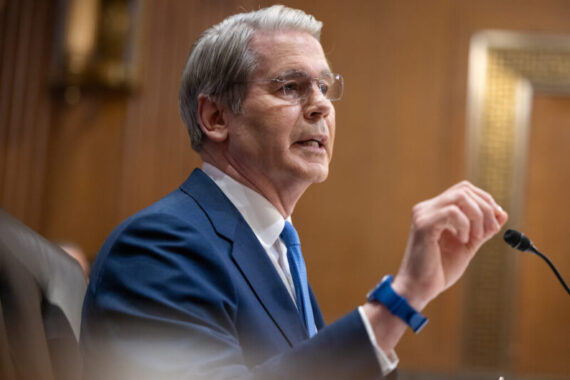
"The economic D-Day" against Iran will begin with the new measures, .S. Treasury Secretary Scott Bessent wrote in an opinion article published in the Financial Times.
August 24, 2026
T
he United States and Iran traded threats over a new economic confrontation on Monday, with Washington preparing what it described as an unprecedented sanctions campaign and Tehran warning it could halt all oil exports from the Persian Gulf if the pressure continues.
U.S. Treasury Secretary Scott Bessent was due to unveil new sanctions targeting countries and companies that continue trading with Iran, describing the campaign as “the single greatest financial offensive ever marshaled against an adversary.”
The measures come after months of war between the United States, Israel and Iran that have damaged Iran’s military and economic infrastructure while disrupting energy markets and shipping through the Strait of Hormuz.
“The economic D-Day” will begin with the new measures, Bessent wrote in an opinion article published in the Financial Times, warning countries that continue doing business with Iran that they could face consequences.
Iran responded with a threat to dramatically escalate the economic confrontation.
Mohsen Rezaei, secretary of Iran’s Supreme National Security Council, said Tehran could stop all oil exports from the Persian Gulf if the U.S. economic campaign continued.
“If the economic war continues, not a single drop of oil will be exported,” Rezaei said in a social media post, adding that Iran would regard countries supporting Washington’s economic campaign as participating in an act of war.
The warning raises the possibility of a further disruption to global energy markets. The Strait of Hormuz, through which a major share of the world’s oil supplies normally passes, has already been brought close to a standstill by the conflict.
Iran retains missile and drone capabilities that it has used against U.S. allies in the Gulf and has threatened commercial shipping in the strategic waterway.
The new U.S. sanctions campaign comes as Washington and Tehran remain far from a negotiated settlement. Although direct military strikes between the two countries have stopped for several weeks, the two sides have yet to resume substantive negotiations.
The conflict began on February 28 with U.S. and Israeli strikes on Iran. Months of fighting have killed thousands of people, most of them in Iran and Lebanon, and inflicted extensive damage on Iranian infrastructure.
Iran also suffered the killing of its Supreme Leader Ayatollah Ali Khamenei during the conflict, while the United States has reported 18 military personnel killed and more than 750 wounded.
Despite the economic pressure, Tehran has maintained a defiant public stance. Iranian officials, however, have acknowledged that the country’s economy was already under severe strain before the war because of years of sanctions, high inflation, currency weakness and energy shortages.
The war has added to those problems by damaging infrastructure, disrupting trade and reducing production, leaving Tehran facing major reconstruction costs.
Iranian officials have warned that further economic pressure could deepen hardship, fuel public discontent and undermine the government’s legitimacy.
Washington is also seeking support from major trading partners, particularly China, which has remained one of Iran’s most important economic partners.
Bessent has urged Beijing to cooperate with the U.S. campaign, noting that China has historically obtained a large share of its oil imports from the Gulf.
China has rejected the use of economic pressure as a solution to the conflict.
“Sanctions and pressure do not help resolve the problem,” a spokesperson for China’s embassy in Washington said, while calling for diplomacy.
Recommended
With direct U.S.-Iran talks stalled, several countries have attempted to mediate between the two sides. Qatar, Pakistan and Turkey have all been involved in diplomatic efforts aimed at preventing a further escalation.
Pakistan’s army chief, Field Marshal Asim Munir, was expected to visit Tehran on Monday as part of Islamabad’s efforts to promote regional peace and security. Pakistani officials said the visit would include discussions on the latest developments and Washington’s threatened sanctions.
The economic confrontation comes at a particularly sensitive moment for global energy markets. Any further disruption to Gulf oil exports could send prices sharply higher and increase pressure on countries already struggling with elevated energy costs.
For Washington, the sanctions campaign is intended to force Iran back to the negotiating table by increasing the economic cost of refusing U.S. demands.
For Tehran, the threat to halt oil exports represents an attempt to demonstrate that Iran can impose significant costs on the United States and its allies if economic pressure continues.
The confrontation therefore risks developing into a wider contest over energy, trade and financial access, even as military operations remain suspended.
With neither side showing signs of abandoning its core demands, the latest exchange of threats suggests that the six-month conflict has entered a new phase — one in which economic pressure and control of global energy supplies could prove as important as military power.
(Source: Reuters)

Politics Today is dedicated to publishing insightful analyses in order to understand the changing nature of contemporary politics. It aims to contribute to the sound and constructive discussion of international affairs.
You can see how this popup was set up in our step-by-step guide: https://wppopupmaker.com/guides/auto-opening-announcement-popups/

Stay informed by subscribing to
our weekly newsletter.
You can see how this popup was set up in our step-by-step guide: https://wppopupmaker.com/guides/auto-opening-announcement-popups/
You can see how this popup was set up in our step-by-step guide: https://wppopupmaker.com/guides/auto-opening-announcement-popups/
You can see how this popup was set up in our step-by-step guide: https://wppopupmaker.com/guides/auto-opening-announcement-popups/
You can see how this popup was set up in our step-by-step guide: https://wppopupmaker.com/guides/auto-opening-announcement-popups/