Lula’s Victory in Brazil: A Historic Win, Limited Power

October 28, 2026

Lula won the presidency, but Congress shifted to the right. Bolsonaro’s Liberal Party (PL) will hold 121 of the 513 seats in the Chamber of Deputies and 28 of the 81 Senate seats, while the left will hold 124 seats in the lower house and 16 in the Senate.
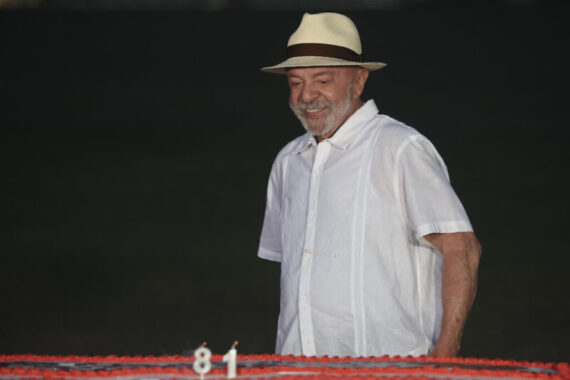
Brazilian President Luiz Inacio Lula da Silva, the Workers' Party (PT) candidate who won the presidential runoff election on Sunday, celebrates his 81st birthday, in Brasilia, Brazil, October 27, 2026. Photo by Anadolu Images.

L

ula won Brazil’s presidential election, but Congress shifted to the right. Bolsonaro’s Liberal Party will hold 121 of the 513 seats in the Chamber of Deputies and 28 of the 81 Senate seats, while the left will hold 124 seats in the lower house and 16 in the Senate. Lula secured the presidency, but he will have to govern alongside a more right-leaning Congress. Although the Workers’ Party has never secured a majority, the strengthening of its opponents will make building the support necessary to implement its agenda more difficult and politically costly.

Lula da Silva has made history in Brazilian democracy, both by securing a fourth presidential term and by becoming the first president to win a runoff election after finishing second in the first round.

In the October 4 first round, he trailed his rival, Flávio Bolsonaro, by 2.2 million votes. On October 25, however, he received 64.25 million votes, defeating Bolsonaro by approximately 4.4 million votes. The message from the ballot box is clear, but it has its limits: Winning the presidency does not mean gaining control over every center of power in the country. Although voters have given Lula a mandate to govern, doing so without negotiation and compromise will not be easy.

How did Lula achieve victory?

First, voter turnout played a decisive role. The abstention rate fell from 21.1 percent to approximately 19 percent, meaning that nearly three million fewer voters stayed home. Between the two rounds, Lula gained 10.3 million additional votes, while Flávio Bolsonaro gained only 3.6 million.

Second, Lula made important geographical gains. Following his October 4 defeat, he established two priorities: expanding his electoral base in the northeast and reducing voter abstention. He increased his vote total in the northeast from 21.4 million to 24.4 million and reclaimed Minas Gerais, the only state to switch sides, with 50.4 percent of the vote.

Third, his campaign successfully combined street-level mobilization with digital organizing. Large rallies were complemented by a digital army coordinated by lawmaker André Janones through the WhatsApp group “Exército do Lula” (Lula’s Army), which brought together approximately 11 million people.

Lula also introduced voter-friendly economic promises, including exempting gasoline from federal taxes, debt forgiveness for microbusiness owners, and an expansion of the Pé-de-Meia program. At the same time, he warned that Flávio would cut social spending and surrender Brazil’s sovereignty to Trump.

The more difficult question is how much of Lula’s victory reflected genuine support for his political agenda and how much resulted from opposition to the return of Bolsonarism. Initial analyses emphasize voter mobilization and grassroots organization. Concern about a possible Flávio victory was probably just as influential as enthusiasm for Lula himself.

Lula holds the Presidency, but the right gains strength in Congress

Lula won the presidency, but Congress shifted to the right. Bolsonaro’s Liberal Party (PL) will hold 121 of the 513 seats in the Chamber of Deputies and 28 of the 81 Senate seats, while the left will hold 124 seats in the lower house and 16 in the Senate.

Lula will therefore have to govern alongside a more right-leaning Congress. Although the Workers’ Party (PT) has never secured a parliamentary majority, the strengthening of its opponents will make assembling the support required to implement its agenda more difficult and politically costly.

In the Chamber of Deputies, Centrão will play a crucial role in forming a majority. An informal political grouping composed predominantly of centrist and center-right parties, Centrão is known for its pragmatism and its practice of negotiating political support in exchange for influence over ministries, government appointments, and budgetary resources.

Hugo Motta, the speaker of the Chamber of Deputies and one of Centrão’s central figures, has already secured the support of 273 lawmakers, exceeding the 257 votes required for his reelection. However, this support does not automatically translate into votes for the government.

Passing budgets and reforms through Congress will force Lula into political negotiations, potentially requiring concessions on his policy agenda. Nevertheless, the outlook is not entirely pessimistic: Motta’s rapprochement with Lula during the election campaign could create room for compromise.

Lula will also face a more conservative Senate, where he must negotiate support for his reforms and government appointments. The election of the Senate president will be particularly important because it will determine who controls the legislative agenda and the pace of voting.

Moreover, upcoming vacancies on the Supreme Federal Court resulting from judicial retirements will make the Senate a key arena in the struggle over Brazil’s institutional balance.

Has Bolsonarism been defeated?

Flávio lost the presidency, but Bolsonarism retains considerable political strength. He received more than 59 million votes, while the Liberal Party (PL), despite lacking an outright majority, will become the largest individual party in both the Chamber of Deputies and the Senate. According to a count conducted by local media, 16 of the elected governors supported his candidacy.

Following his defeat, Flávio announced that he would not recognize the result and would seek to annul the election.

His main argument centered on Supreme Federal Court Justice Cristiano Zanin’s decision to extend voting by two hours because of reported transportation difficulties, particularly in Salvador and São Paulo. Zanin had previously served as Lula’s lawyer.

The extension applied only to polling stations that remained open; those that had already closed were not reopened. It should also be noted that both campaigns had requested extensions, although their requests concerned different geographical areas.

The decision, described by the media as unprecedented, sparked legal debate, and the Electoral Public Prosecutor’s Office opposed extending voting hours.

However, the controversy does not, in itself, demonstrate that irregularities affected the election result. The president of the Superior Electoral Court (TSE) confirmed that the process was secure, while the presidents of both the Senate and the Chamber of Deputies recognized Lula’s victory.

After the victory: The post-Lula era

The election victory has not eliminated economic uncertainty. Markets had expected Flávio to win. Following Lula’s victory, the US dollar rose by more than 10 percent against the Brazilian real, while a sharp stock market decline triggered a temporary suspension of trading.

Lula faces a challenging economic environment, with very limited room for maneuver. In August, gross public debt reached 82.9 percent of GDP, while the benchmark interest rate stood at 13.75 percent.

Growth forecasts for 2027 hover around just 1.3 percent. High interest rates make government borrowing more expensive and restricts the administration’s ability to respond to social demands.

Lula will need to reconcile his campaign promises with fiscal discipline. The government’s target for 2027 is a primary budget surplus equivalent to 0.5 percent of GDP, excluding interest payments.

However, measures announced during the campaign are increasing pressure on public finances. According to calculations published by Folha de S. Paulo, the total cost of these measures could reach 290 billion reais, while the 2027 budget requires adjustments of at least 39.9 billion reais.

Lula’s political test will be determining which promises to prioritize, how to finance them, and what compromises will be necessary to implement them.

Beyond these difficulties lies another challenge: succession.

Lula turns 81 on October 27, and the continuity of his political project requires developing leadership capable of competing electorally without depending on his presence on the ballot. This is essential for the long-term continuity of the left.

Fernando Haddad had been considered a potential candidate for 2030, but his latest defeat against Tarcísio de Freitas in São Paulo has considerably weakened his electoral standing.

The composition of Lula’s cabinet and his first economic decisions will provide an opportunity to assess how he intends to address these two challenges.

His task is to transform a personal electoral victory into tangible government achievements while establishing political continuity that can endure beyond his presidency.

In other words, the central question for the coming period is whether Lula can turn his personal triumph into sustainable governance and lasting political continuity.


Foreign policy implications

Lula’s victory has slowed the regional right-wing wave, at least to some extent. Some analysts believe that this wave may have already peaked, given the declining popularity of Argentina’s Javier Milei and Chile’s José Antonio Kast.

However, it is still too early to speak of a new left-wing wave. Kast congratulated Lula by telephone, while Milei, who supported Bolsonaro’s campaign and called Lula a “thief” in July, had remained silent as of Monday.

Sovereignty in relations with Washington will remain a central pillar of Brazil’s foreign policy.

The additional tariffs of up to 50 percent imposed on certain Brazilian products in 2025 transformed trade into an instrument of political pressure.

Lula is expected to continue diversifying Brazil’s partnerships through China, BRICS, and the Global South to expand his negotiating room without abandoning dialogue with the United States.

The real challenge will be translating this diplomatic autonomy into concrete economic benefits.

For Türkiye, this continuity presents opportunities within the strategic partnership already established between the two countries.

Brazil is Türkiye’s main trading partner in South America, and its influential position within MERCOSUR, the South American regional economic and customs union, makes it a key counterpart for expanding Türkiye’s economic presence in the region.

More recently, bilateral cooperation has acquired a new dimension through developments in the defense industry. The defense agreement approved in September 2026 has translated into concrete projects involving joint research and development, technology transfer, and cooperation in equipment production and procurement.

From this perspective, Lula’s reelection offers Türkiye the prospect of political continuity, creating opportunities to advance joint projects and give bilateral relations greater industrial and technological depth.

(Originally published in Turkish by Kriter)

Melike Hocaoğlu Çağlıöz is an Amsterdam-based independent foreign policy analyst and researcher. She holds an MA in Latin American Studies from the University of Amsterdam, and her work focuses on Latin America and Caribbean Countries, Türkiye–Latin America relations, foreign policy, and international political economy. She has previously held various roles aimed at strengthening economic and diplomatic relations between Türkiye and Latin American countries and regularly contributes analysis and opinion pieces to international media outlets.